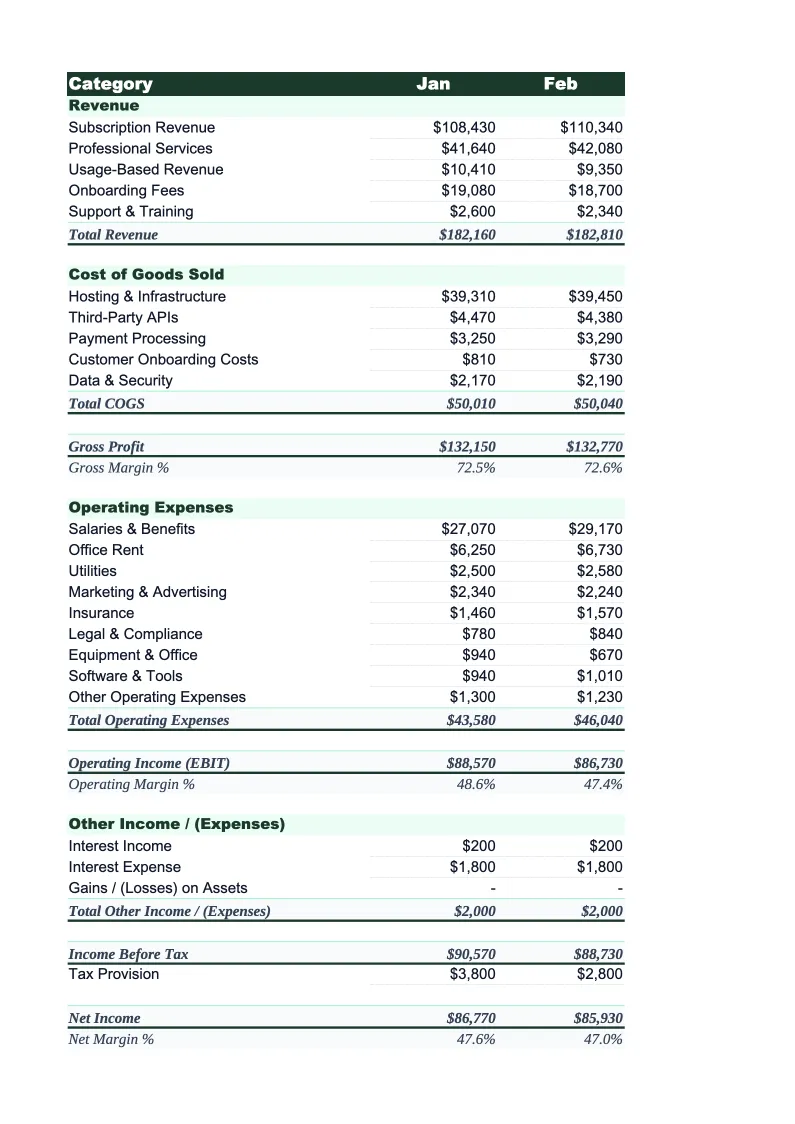
SaaS Income Statement Template
A SaaS income statement template with MRR, ARR, cloud infrastructure costs, and the operating expense structure investors expect — so you can track gross margin and burn without rebuilding a spreadsheet every quarter.
What's Inside This SaaS Income Statement Template
This template includes 4 worksheets, each designed for a specific part of your saas financial workflow:
Monthly Income Statement
The core P&L worksheet built around the standard SaaS revenue and cost structure.
Annual Summary
A 12-month rollup that consolidates your monthly income statements into a single view, with each revenue and expense line aggregated automatically from the monthly sheets.
SaaS Metrics
A dedicated worksheet that tracks the subscription metrics your income statement alone can't show.
Unit Economics
A worksheet for calculating and tracking customer acquisition cost (CAC), customer lifetime value (LTV), and the LTV:CAC ratio over time.
SaaS Income Statement Template Features
- Subscription revenue split by pricing tier with MRR and ARR auto-calculated
- Cost of revenue structured for SaaS: infrastructure, payment processing, and CS costs
- Operating expenses in the standard investor format: R&D, S&M, and G&A
- MRR waterfall with new, expansion, contraction, and churned MRR tracked separately
- Net revenue retention (NRR) and Rule of 40 score calculated automatically
- Unit economics sheet: CAC, LTV, LTV:CAC ratio, and payback period by month
How to Use This SaaS Income Statement Spreadsheet
Download the .xlsx file and open it in Excel or Google Sheets — no macros or plugins required. Start with the Monthly Income Statement sheet: review the pre-loaded revenue tiers and adjust the plan names to match your pricing (for example, Starter, Professional, Enterprise). Add or remove tiers as needed — the formulas use range references and pick up new rows automatically. Then review the cost of revenue and operating expense line items and rename any labels that don't match your chart of accounts. This setup takes 15–20 minutes and you only do it once.
Each month, enter your subscription revenue by tier, professional services revenue, and any usage or add-on charges at the top. Then fill in cost of revenue: pull your cloud infrastructure bill from AWS or GCP, add payment processing fees (typically 2.2–2.9% of revenue), and allocate the portion of customer success salaries tied to service delivery. Work down through R&D, S&M, and G&A using your payroll reports and expense categorizations. The gross profit, operating income, EBITDA, and net income lines calculate automatically. Then open the SaaS Metrics sheet and enter your new, expansion, contraction, and churned MRR for the month.
15 minutes from download to your first SaaS income statement
Download the template, enter your MRR by tier and operating expenses, and get gross margin, NRR, and your Rule of 40 score — all calculated automatically.
Why Every SaaS Company Needs a Proper Income Statement
SaaS income statements look different from those of other businesses, and that difference matters when you're talking to investors, lenders, or a board. Revenue isn't just a single top-line number — it's subscription revenue, professional services, and usage or add-on charges, each with different margin profiles. Cost of revenue isn't product cost in the traditional sense — it's infrastructure spend, payment processing, and the delivery-side portion of customer success. And operating expenses need to be split into R&D, Sales and Marketing, and G&A, because that's how investors and acquirers model efficiency ratios. A generic business income statement won't capture any of this, which means you'll spend hours reformatting it every time you need to share it with someone who knows SaaS.
Gross margin is the foundational number in a SaaS income statement. Well-run SaaS companies typically target 70–80% gross margin at scale — enough headroom to fund the S&M and R&D spend required to grow while still generating positive cash flow eventually. Early-stage companies often run lower (60–70%) because they're over-provisioned on infrastructure relative to current revenue and haven't yet optimized their cloud spend. Gross margin below 60% usually signals a structural problem: too much human cost tied to service delivery, underpriced plans, or infrastructure that doesn't scale efficiently. The income statement is where this shows up first, before it appears in any other metric.
SaaS Industry at a Glance
Financial templates built for software-as-a-service businesses managing subscription billing, ARR growth, and recurring revenue operations.
Revenue Drivers
- monthly recurring revenue (MRR)
- annual contract value (ACV)
- seat-based or usage-based billing
- professional services and onboarding fees
- add-ons and tier upgrades
Key Cost Categories
- cloud infrastructure (AWS, GCP, Azure)
- employee salaries and benefits (engineering, sales, CS, marketing)
- customer acquisition (ads, events, SDR costs)
- SaaS tools and subscriptions
- payment processing fees
- R&D and product development
Typical Margins
Gross: 60-80% · Net: -5% to 20% depending on growth stage
Seasonality
Relatively flat month-to-month with Q4 spikes from enterprise budget cycles. Annual contract renewals cluster in January and July.
Key Performance Indicators
SaaS Income Statement Template FAQ
More SaaS Templates
SaaS Balance Sheet Template for Excel
$29
SaaS Budget Template for Excel
$29
SaaS Business Plan Template for Excel
$39
SaaS Cash Flow Template for Excel
$29
SaaS Expense Tracker Template for Excel
$29
SaaS Financial Model Template for Excel
$29
SaaS Invoice Template for Excel
$29
SaaS KPI Dashboard Template for Excel
$29
SaaS P&L Template for Excel
$29
SaaS Pro Forma Template for Excel
$29
SaaS Project Budget Template for Excel
$29
SaaS Sales Forecast Template for Excel
$29
SaaS Valuation Template for Excel
$29
More Income Statement Templates
Accounting Firm Income Statement Template for Excel
$29
Auto Repair Income Statement Template for Excel
$29
Car Wash Income Statement Template for Excel
$29
Church Income Statement Template for Excel
$29
Cleaning Service Income Statement Template for Excel
$29
Coffee Shop Income Statement Template for Excel
$29
SaaS Income Statement Template
$29