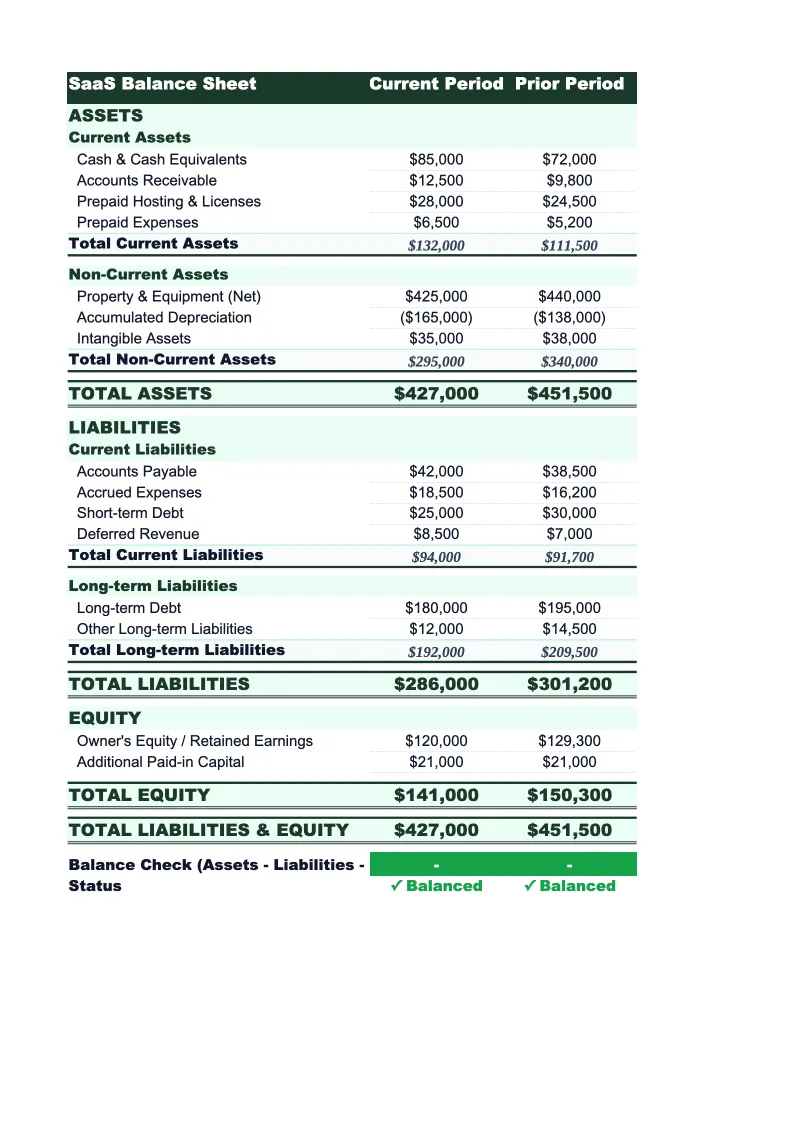
SaaS Balance Sheet Template
Track what your SaaS company owns, owes, and is worth — a balance sheet built for subscription businesses with deferred revenue schedules, capitalized software development costs, and a structure lenders and investors recognize.
What's Inside This SaaS Balance Sheet Template
This template includes 4 worksheets, each designed for a specific part of your saas financial workflow:
Balance Sheet
The core financial statement organized around a SaaS company's chart of accounts.
Deferred Revenue Schedule
Deferred revenue is the most distinctive item on a SaaS balance sheet, and this sheet exists specifically to manage it correctly.
Software Capitalization Register
Internal-use software developed by a SaaS company can be capitalized under ASC 350-40, which allows engineering labor and direct costs incurred during the application development stage to be recorded as a non-current asset and amortized over the software's useful life rather than expensed immediately.
Period Comparison
A side-by-side view of two balance sheet dates for trend analysis, investor reporting, board presentations, or due diligence preparation.
SaaS Balance Sheet Template Features
- Deferred revenue schedule that tracks annual and multi-year subscription contracts and splits into current vs. long-term balance sheet buckets
- Capitalized software development cost register with ASC 350-40 stage classification and monthly amortization calculations
- Accounts receivable with allowance for doubtful accounts — net AR calculation built in
- Deferred customer acquisition cost tracking (capitalized commissions under ASC 340-40 amortized over contract term)
- Accounting equation check that automatically flags any imbalance between assets and liabilities plus equity
- Period-over-period comparison for investor reporting, board packages, and due diligence
How to Use This SaaS Balance Sheet Spreadsheet
Start with the Deferred Revenue Schedule. Pull your active subscription contracts from your billing system (Stripe, Chargebee, or your CRM) and enter each contract with its start date, end date, total contract value, and billing date. The sheet calculates how much revenue has been earned to date and how much remains deferred, then splits the total into current (next 12 months) and long-term (beyond 12 months) buckets that feed directly into the balance sheet. If your company primarily sells month-to-month subscriptions, the deferred revenue balance will be small; if you sell annual or multi-year contracts, this schedule can represent your largest current liability and needs to be accurate.
Next, complete the Software Capitalization Register if your company has been capitalizing internal software development costs. List each major software project or product module, classify it by development stage (only application development stage costs are capitalized under ASC 350-40), enter the total capitalized cost and start of amortization, and the sheet handles monthly amortization and net book value. Then fill in the balance sheet directly: pull cash from your bank accounts, accounts receivable from your billing system aging report, prepaid expenses from your credit card statements, and payables and accrued expenses from your accounting software. Equity flows from paid-in capital records and accumulated retained earnings or deficit.
15 minutes from download to your first SaaS balance sheet
Download the template, enter your subscription contracts and accounts, and see your SaaS company's full financial position — deferred revenue, capitalized software, and equity all in one place.
Why Every SaaS Company Needs a Balance Sheet Template
Most SaaS founders track MRR and ARR closely but rarely maintain an organized balance sheet. The income statement tells you whether revenue is growing; the balance sheet tells you how much runway you have, what your obligations are, and whether the equity story you're telling investors holds up to scrutiny. Two items make SaaS balance sheets fundamentally different from other businesses: deferred revenue and capitalized software. Both are often handled incorrectly, and both matter a great deal to anyone evaluating the financial health of a software company.
Deferred revenue is the most misunderstood SaaS balance sheet item. When a customer pays $12,000 for an annual contract in January, you collect $12,000 in cash — but you've only earned $1,000 per month as you deliver the service. The remaining balance is a liability on your balance sheet, not revenue. SaaS companies that recognize annual contracts entirely upfront overstate revenue and understate liabilities, which looks good in the short term but creates accounting problems and erodes investor trust during due diligence. A properly maintained deferred revenue schedule also gives you a forward-looking picture of committed revenue: if you have $500,000 in deferred revenue today, that's $500,000 of revenue you will recognize over the coming months from contracts already signed, regardless of new bookings.
SaaS Industry at a Glance
Financial templates built for software-as-a-service businesses managing subscription billing, ARR growth, and recurring revenue operations.
Revenue Drivers
- monthly recurring revenue (MRR)
- annual contract value (ACV)
- seat-based or usage-based billing
- professional services and onboarding fees
- add-ons and tier upgrades
Key Cost Categories
- cloud infrastructure (AWS, GCP, Azure)
- employee salaries and benefits (engineering, sales, CS, marketing)
- customer acquisition (ads, events, SDR costs)
- SaaS tools and subscriptions
- payment processing fees
- R&D and product development
Typical Margins
Gross: 60-80% · Net: -5% to 20% depending on growth stage
Seasonality
Relatively flat month-to-month with Q4 spikes from enterprise budget cycles. Annual contract renewals cluster in January and July.
Key Performance Indicators
SaaS Balance Sheet Template FAQ
More SaaS Templates
SaaS Budget Template for Excel
$29
SaaS Business Plan Template for Excel
$39
SaaS Cash Flow Template for Excel
$29
SaaS Expense Tracker Template for Excel
$29
SaaS Financial Model Template for Excel
$29
SaaS Income Statement Template for Excel
$29
SaaS Invoice Template for Excel
$29
SaaS KPI Dashboard Template for Excel
$29
SaaS P&L Template for Excel
$29
SaaS Pro Forma Template for Excel
$29
SaaS Project Budget Template for Excel
$29
SaaS Sales Forecast Template for Excel
$29
SaaS Valuation Template for Excel
$29
More Balance Sheet Templates
SaaS Balance Sheet Template
$29