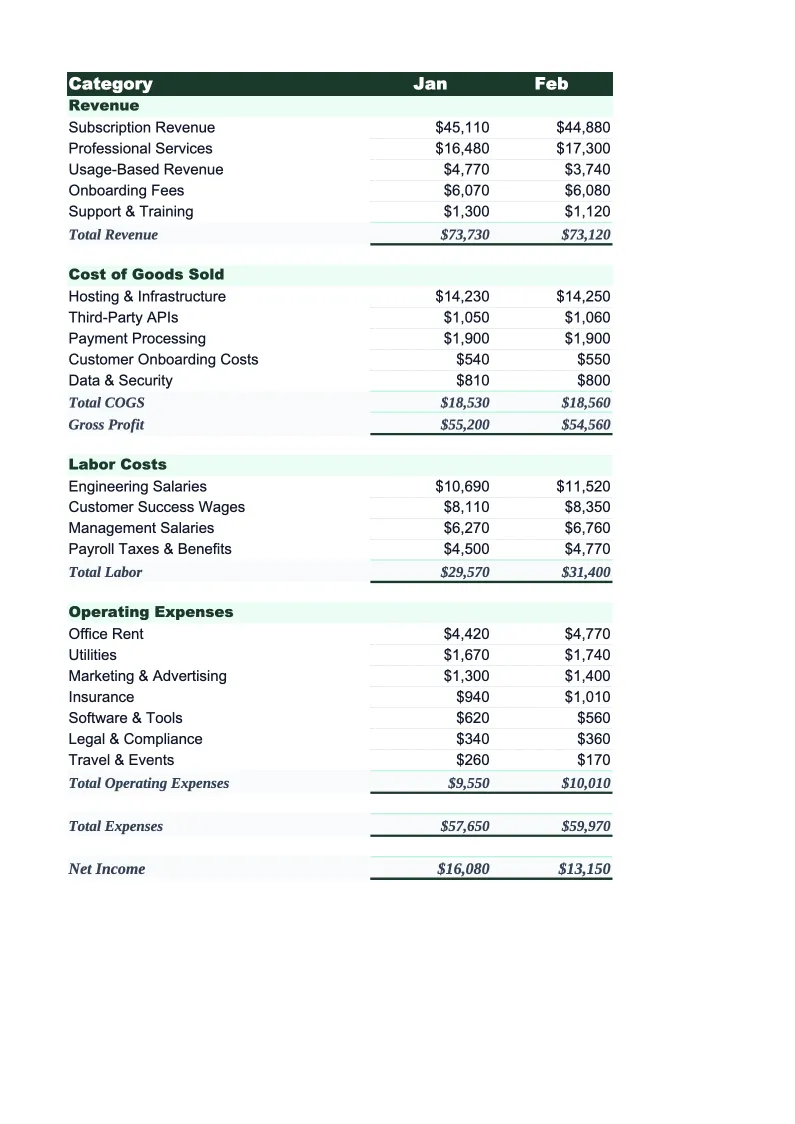
SaaS Budget Template
Plan and track your SaaS company's budget with a template built for recurring revenue businesses — headcount by department, cloud costs, ARR projections, and burn rate in one spreadsheet.
What's Inside This SaaS Budget Template
This template includes 5 worksheets, each designed for a specific part of your saas financial workflow:
Revenue Budget
Projects your recurring revenue from the ground up using standard SaaS drivers.
Headcount Plan
Breaks out your largest cost — people — by department: Engineering & Product, Sales, Marketing, Customer Success, and G&A.
Operating Expenses
Covers all non-headcount spend across the standard SaaS cost categories: cloud infrastructure (AWS, GCP, Azure), SaaS tools and subscriptions, payment processing fees, sales and marketing programs (ads, events, sponsored content), office and facility costs, and professional services.
Monthly P&L Summary
A rolling 12-month profit and loss view that pulls from the Revenue Budget, Headcount Plan, and Operating Expenses sheets.
Dashboard
A one-page summary with the metrics SaaS founders and CFOs actually track: ARR, MRR growth, gross margin, burn rate, runway (months), CAC payback period, and LTV:CAC ratio.
SaaS Budget Template Features
- MRR/ARR revenue model with new ARR, expansion, and churn inputs
- Headcount plan by department with fully-loaded salary calculations
- Operating expense budget organized by SaaS cost categories
- Monthly P&L with gross margin and burn rate tracking
- Cash runway calculator based on starting cash balance
- Dashboard with LTV:CAC ratio, CAC payback, and NRR
How to Use This SaaS Budget Spreadsheet
Start with the Revenue Budget sheet. Enter your current MRR as your starting point, then fill in monthly assumptions for new ARR, expansion revenue, and churn. These numbers don't need to be perfect — base them on your last 6–12 months of actuals if you have them, or use conservative estimates if you're earlier stage. The sheet calculates net MRR growth, ARR, and NRR automatically, giving you a revenue baseline that every other sheet references.
Move to the Headcount Plan next, since people are typically 60–75% of a SaaS company's total expenses. Enter each current employee by department and planned hire date, along with their salary and your benefits load percentage (typically 15–25% on top of base salary). Model out your full-year hiring plan — you'll immediately see how each hire affects monthly burn and when your cash runway starts to tighten. Then complete the Operating Expenses sheet for cloud costs, SaaS tools, marketing programs, and any other non-headcount spend.
15 minutes from download to your first SaaS budget
Download the template, enter your MRR and hiring plan, and see your full financial picture — ARR growth, burn rate, runway, and unit economics all in one place.
Why Every SaaS Company Needs a Budget Template
SaaS budgeting is harder than it looks because the cost structure doesn't match the revenue model. Revenue is predictable and recurring; expenses — especially headcount — are lumpy and front-loaded. You hire an engineer in January to ship a feature that generates revenue in Q3. You spend on sales and marketing this quarter to close deals that show up as ARR next quarter. Without a budget that models this timing explicitly, it's easy to run out of runway even when the business is growing.
The categories that matter most in a SaaS budget are not the same as a traditional business. Gross margin is driven by cloud infrastructure and customer success costs, not inventory. CAC payback period — how many months of subscription revenue it takes to recover the cost of acquiring a customer — is the unit economic metric that determines whether your growth is sustainable. And burn multiple (net burn divided by net new ARR) tells you how efficiently you're converting cash into recurring revenue. A good SaaS budget tracks all of these, not just revenue and expenses.
SaaS Industry at a Glance
Financial templates built for software-as-a-service businesses managing subscription billing, ARR growth, and recurring revenue operations.
Revenue Drivers
- monthly recurring revenue (MRR)
- annual contract value (ACV)
- seat-based or usage-based billing
- professional services and onboarding fees
- add-ons and tier upgrades
Key Cost Categories
- cloud infrastructure (AWS, GCP, Azure)
- employee salaries and benefits (engineering, sales, CS, marketing)
- customer acquisition (ads, events, SDR costs)
- SaaS tools and subscriptions
- payment processing fees
- R&D and product development
Typical Margins
Gross: 60-80% · Net: -5% to 20% depending on growth stage
Seasonality
Relatively flat month-to-month with Q4 spikes from enterprise budget cycles. Annual contract renewals cluster in January and July.
Key Performance Indicators
SaaS Budget Template FAQ
More SaaS Templates
SaaS Balance Sheet Template for Excel
$29
SaaS Business Plan Template for Excel
$39
SaaS Cash Flow Template for Excel
$29
SaaS Expense Tracker Template for Excel
$29
SaaS Financial Model Template for Excel
$29
SaaS Income Statement Template for Excel
$29
SaaS Invoice Template for Excel
$29
SaaS KPI Dashboard Template for Excel
$29
SaaS P&L Template for Excel
$29
SaaS Pro Forma Template for Excel
$29
SaaS Project Budget Template for Excel
$29
SaaS Sales Forecast Template for Excel
$29
SaaS Valuation Template for Excel
$29
SaaS Budget Template
$29