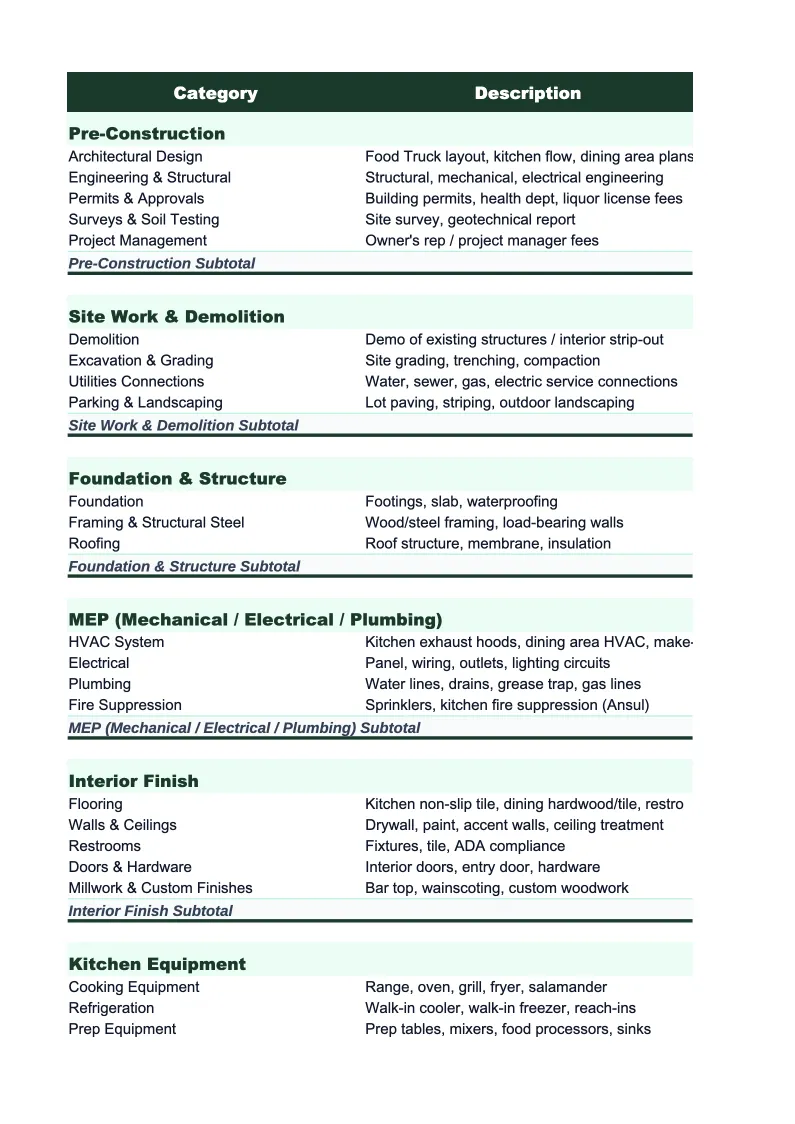
Food Truck Project Budget Template
Budget and track every dollar of a food truck build, conversion, or new launch — from vehicle purchase and kitchen equipment to permits, branding, and working capital reserve.
What's Inside This Food Truck Project Budget Template
This template includes 7 worksheets, each designed for a specific part of your food truck financial workflow:
Project Setup
Enter your food truck project details here first: truck name or concept, target launch date, planned service territory, total projected budget, and your financing breakdown (personal savings, SBA loan, equipment financing, investor capital).
Truck & Vehicle
A line-item budget for everything related to acquiring and preparing the vehicle itself: truck or trailer purchase price, vehicle inspection and pre-purchase mechanical assessment, body modifications (service windows, exterior shelving, pass-through), generator or shore power hookup, ventilation and hood rough-in, propane or gas line installation, fire suppression system, vehicle wrap and exterior graphics, and initial vehicle insurance deposit.
Kitchen Equipment
Separate budget tracker for all cooking, refrigeration, prep, and service equipment installed in the truck.
Permits & Licensing
Tracks all the permits and licenses required to operate — one of the most commonly underestimated cost categories in a food truck launch.
Pre-Launch Costs
Covers all the one-time startup expenses beyond the truck and equipment: commissary kitchen setup fees, initial food and beverage inventory, packaging and disposables initial order (containers, napkins, utensils, condiments), uniforms and branded apparel, menu design and printing, logo and branding design, website setup, social media photography, initial marketing and launch promotion costs, and 3–6 months of projected commissary fees and insurance premiums held as a working capital reserve.
Budget vs Actual
Side-by-side comparison of your original budget against actual costs incurred to date, organized by the same categories as the other sheets.
Dashboard
A one-page project summary with pre-built charts showing total budget versus actual spend by category, percentage of budget committed, and projected final cost.
Food Truck Project Budget Template Features
- Pre-built food truck startup cost categories (vehicle, kitchen equipment, permits, pre-launch, working capital)
- Equipment budget broken out by station — cooking, refrigeration, prep, service, and POS technology
- Committed-not-yet-paid column to track deposits and purchase orders before final invoices arrive
- Permit tracker covering health department, fire, zoning, and event vendor requirements by category
- Pre-launch soft cost tracker for branding, marketing, initial inventory, and commissary setup fees
- Visual dashboard with budget vs actual by category and cost-per-category benchmark ranges
How to Use This Food Truck Project Budget Spreadsheet
Start with the Project Setup sheet. Enter your concept name, target launch date, planned service territory, and total projected budget along with your financing breakdown — personal savings, equipment loan, SBA microloan, or investor capital. The setup sheet gives you a summary view of your four main cost buckets before you get into line items. Use it to gut-check whether your total capital matches what you've raised or can realistically borrow. Then open the Truck & Vehicle sheet and review the pre-loaded categories; adjust them to reflect your specific project — a custom new build looks different from a step van conversion, and a trailer setup has different line items than a truck.
As vendor quotes and builder estimates come in, enter them in the relevant sheets alongside your original estimates. The Budget vs Actual sheet shows variance as soon as a category has both a budget and an actual or committed amount. Log costs as deposits and invoices arrive, and update the committed-not-yet-paid column whenever you pay a deposit, sign a contract, or place an equipment order. Most operators find it useful to update the tracker once a week during the build — timed to when they're reviewing builder invoices or checking in with equipment suppliers. This keeps the Dashboard current so any investor, lender, or business partner can see where the project stands at any point.
15 minutes from download to your first project budget
Download the template, enter your build quotes and permit costs, and see your full food truck startup cost — vehicle, equipment, permits, and pre-launch — in one place.
Why Every Food Truck Launch Needs a Dedicated Project Budget
Starting a food truck is significantly cheaper than opening a brick-and-mortar restaurant, but it's not cheap. A realistic all-in startup budget for a new food truck concept — including the vehicle, kitchen equipment, permits, branding, and a working capital reserve — typically runs $75,000–$200,000 depending on whether you're buying new or used, building out raw space inside a truck, and what your local permit costs look like. The problem most new operators run into isn't underestimating any single item — it's that the costs are spread across 30 or 40 different line items across four or five different categories, and small underestimates in each add up to being $15,000–$30,000 short at the worst possible moment: right before launch.
A food truck project budget needs to track three cost areas that behave differently. Vehicle and conversion costs are largely quote-based from fabricators and builders, but they're highly subject to scope creep — every addition to the kitchen layout adds cost and lead time, and many operators end up adding equipment during the build that wasn't in the original quote. Equipment costs are predictable once you have supplier quotes, but used equipment sourced from restaurant auctions or Craigslist requires inspection and may need servicing before installation. Permits and licensing are the most unpredictable — processing times in some cities stretch to 3–4 months, and requirements vary so significantly by county that moving your planned service area across a county line can change your permit requirements entirely. Building in a 10–15% contingency across all categories isn't pessimism; it's standard practice.
Food Truck Industry at a Glance
Financial templates built for food truck operators — from single-unit street vendors to multi-truck fleets. Pre-loaded with commissary fees, fuel costs, permit categories, and event-based revenue tracking.
Revenue Drivers
- Street service (lunch/dinner stops)
- Private catering events
- Corporate events
- Food truck rallies and festivals
Key Cost Categories
- Food costs (COGS)
- Commissary kitchen fees
- Fuel and vehicle maintenance
- Permits and licenses
- Labor
- Payment processing and POS fees
Typical Margins
Gross: 60-70% · Net: 6-15%
Seasonality
Peak revenue in spring and summer; heavily weather-dependent. Winter months significantly slower in northern climates. Event catering provides revenue stability year-round.
Key Performance Indicators
Food Truck Project Budget Template FAQ
More Food Truck Templates
Food Truck Balance Sheet Template for Excel
$29
Food Truck Budget Template for Excel
$29
Food Truck Business Plan Template for Excel
$39
Food Truck Cash Flow Template for Excel
$29
Food Truck Expense Tracker Template for Excel
$29
Food Truck Financial Model Template for Excel
$29
Food Truck Income Statement Template for Excel
$29
Food Truck Invoice Template for Excel
$29
Food Truck KPI Dashboard Template for Excel
$29
Food Truck P&L Template for Excel
$29
Food Truck Pro Forma Template for Excel
$29
Food Truck Sales Forecast Template for Excel
$29
Food Truck Valuation Template for Excel
$29
More Project Budget Templates
Food Truck Project Budget Template
$29