Food Truck Cash Flow Template
Track and project cash flow for your food truck — with event revenue by channel, commissary fees, fuel costs, and a 13-week projection that reflects how mobile food businesses actually move money.
What's Inside This Food Truck Cash Flow Template
This template includes 5 worksheets, each designed for a specific part of your food truck financial workflow:
13-Week Cash Flow
A rolling 13-week view of your food truck's cash inflows and outflows — the most useful planning window for a business where revenue swings by day and season.
Monthly Cash Flow
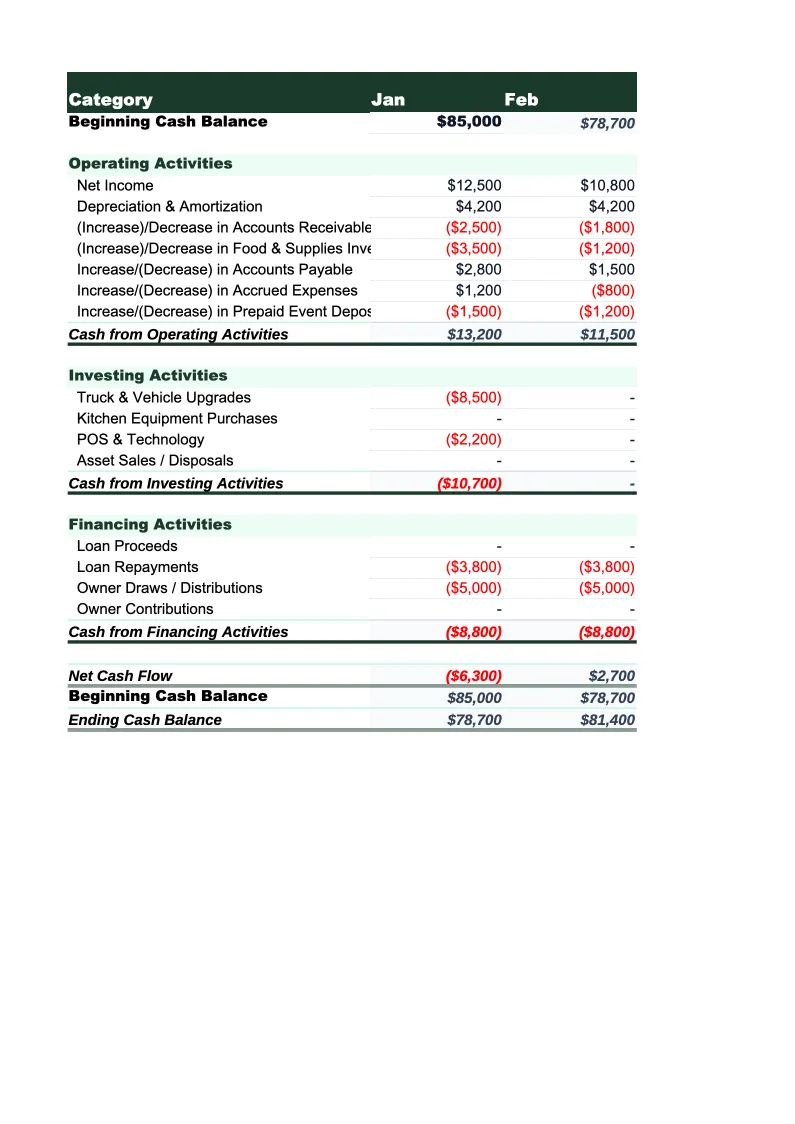
A 12-month indirect-method cash flow statement organized into operating, investing, and financing activities.
Event Revenue Tracker
A dedicated worksheet for logging each event booking — festivals, private catering, corporate lunches, and private parties — with deposit received date, balance due date, and event date.
Annual Summary
A full-year rollup of operating cash flow broken down by revenue channel and major expense category.
Dashboard
A visual overview with four pre-built charts: monthly cash inflows versus outflows, ending cash balance trend across 12 months, revenue breakdown by channel (street vs.
Food Truck Cash Flow Template Features
- 13-week cash projection with revenue split by street, catering, corporate, and festival channels
- Event Revenue Tracker that logs deposits, balances, and event dates to prevent spending ahead of costs
- Indirect-method monthly cash flow with deferred revenue adjustment for catering deposits
- Food cost percentage and commissary cost as % of revenue calculated automatically
- Annual cash runway projection based on average monthly net cash flow
- Revenue-by-channel dashboard showing how each income stream contributes to total cash
How to Use This Food Truck Cash Flow Spreadsheet
Download the .xlsx file and open it in Excel or Google Sheets. Start with the 13-Week Cash Flow sheet — rename the revenue rows to match how your truck actually makes money. Most operators use four rows: street service (your regular daily stops), private catering (weddings, birthday parties, private events), corporate (office lunch routes or company events), and festivals/rallies. Enter your expected collections for the next 13 weeks using your calendar, confirmed bookings, and typical daily street revenue as your guide. Fill in your weekly expense estimates for food costs, commissary, fuel, and payroll, then check the ending balance row to see where you stand.
Move to the Event Revenue Tracker and log every confirmed booking — enter the event date, the deposit you've already collected, and the balance due date. This is the most important step for catering-heavy operators: it shows you which forward cash flows are locked in versus which are still street-dependent. Once your bookings are entered, the tracker feeds your committed revenue into the 13-week view so your projections reflect what's actually in the pipeline. Update it whenever you book a new event or collect a balance payment, and review it at the start of each week alongside your service schedule.
15 minutes from download to your first cash flow projection
Download the template, enter your bookings and weekly service revenue, and see your food truck's full cash picture — 13-week projection, event tracker, and monthly statement included.
Why Food Trucks Need a Dedicated Cash Flow Template
Food trucks run on variable cash flows in a way that even other food-service businesses don't. A restaurant has fixed seating and a predictable daily rhythm. A food truck has a calendar full of decisions — which corner to park on, which festival to register for, whether to take a catering inquiry that conflicts with a busy Saturday route. Each of those decisions has a cash consequence, and making them well requires knowing your actual cash position, not just your bank balance after a weekend of events.
The two cash flow dynamics that distinguish food trucks are the catering deposit cycle and the seasonality gap. Catering deposits — typically 25–50% paid weeks before the event — create a gap between cash received and revenue earned. An operator who spends a deposit on food costs for next week's street service will be short when the catering event arrives and the remaining expenses hit. Separately, most northern-climate food trucks see revenue drop 40–60% from November through February, but expenses don't drop proportionally: commissary fees, insurance, loan payments, and permit renewals continue. Operators who haven't modeled their slow-season cash position often face a cash crunch in February that surprises them even when the math was always visible.
Food Truck Industry at a Glance
Financial templates built for food truck operators — from single-unit street vendors to multi-truck fleets. Pre-loaded with commissary fees, fuel costs, permit categories, and event-based revenue tracking.
Revenue Drivers
- Street service (lunch/dinner stops)
- Private catering events
- Corporate events
- Food truck rallies and festivals
Key Cost Categories
- Food costs (COGS)
- Commissary kitchen fees
- Fuel and vehicle maintenance
- Permits and licenses
- Labor
- Payment processing and POS fees
Typical Margins
Gross: 60-70% · Net: 6-15%
Seasonality
Peak revenue in spring and summer; heavily weather-dependent. Winter months significantly slower in northern climates. Event catering provides revenue stability year-round.
Key Performance Indicators
Food Truck Cash Flow Template FAQ
More Food Truck Templates
Food Truck Balance Sheet Template for Excel
$29
Food Truck Budget Template for Excel
$29
Food Truck Business Plan Template for Excel
$39
Food Truck Expense Tracker Template for Excel
$29
Food Truck Financial Model Template for Excel
$29
Food Truck Income Statement Template for Excel
$29
Food Truck Invoice Template for Excel
$29
Food Truck KPI Dashboard Template for Excel
$29
Food Truck P&L Template for Excel
$29
Food Truck Pro Forma Template for Excel
$29
Food Truck Project Budget Template for Excel
$29
Food Truck Sales Forecast Template for Excel
$29
Food Truck Valuation Template for Excel
$29
Food Truck Cash Flow Template
$29