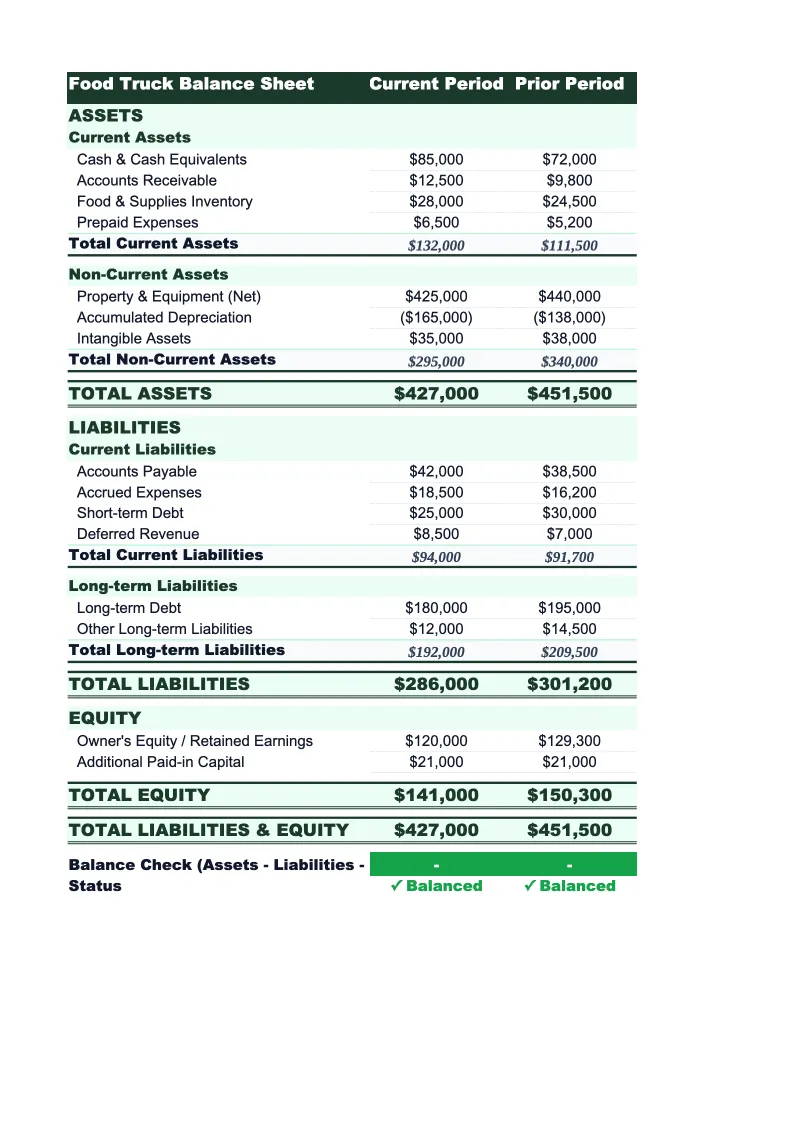
Food Truck Balance Sheet Template
See exactly what your food truck business owns, owes, and is worth — a balance sheet built for mobile food vendors with truck depreciation schedules, commissary security deposits, vehicle loan tracking, and food inventory.
What's Inside This Food Truck Balance Sheet Template
This template includes 4 worksheets, each designed for a specific part of your food truck financial workflow:
Balance Sheet
The core financial statement organized around the food truck chart of accounts.
Fixed Assets
A fixed-asset register tracking the truck, kitchen equipment, and technology — the three asset categories that make up the bulk of a food truck's capital investment.
Inventory Tracker
A period-end count sheet for food and supplies inventory that feeds values into the balance sheet's current assets section.
Period Comparison
A side-by-side view of two balance sheet dates — typically the current period against the prior year, or year-end figures across two years.
Food Truck Balance Sheet Template Features
- Truck and kitchen equipment depreciation schedules with net book value calculations
- Commissary security deposits tracked as a separate current asset line item
- Vehicle loan split into current and long-term portions for accurate liability presentation
- Food and supplies inventory tracker with per-unit cost and days-on-hand calculation
- Accounting equation check — automatically flags any imbalance between assets and liabilities plus equity
- Period-over-period comparison for lender applications and fleet expansion planning
How to Use This Food Truck Balance Sheet Spreadsheet
Start with the Fixed Assets sheet. Pull the purchase paperwork for your truck, any installed kitchen equipment, and your generator, and enter each asset with its original cost and purchase date. If you bought a used truck, use what you actually paid — not the previous owner's book value. Assign a useful life and let the sheet calculate annual depreciation and net book value. This step takes 20–30 minutes the first time but only a few minutes to update when you add or replace an asset. The totals from this sheet flow directly into the balance sheet's non-current assets section, so accuracy here matters.
Next, complete the Inventory Tracker with a physical count of your food stock and supplies. Most food truck operators can do a full count in under 10 minutes given how limited storage space is. Enter current purchase costs from your most recent supplier invoices — use what you paid, not retail price. Then fill in the rest of the balance sheet: cash from your bank statement, commissary deposits from your commissary agreement, accounts payable from any outstanding supplier balances, sales tax payable from your POS summary, and your truck loan balance from the latest lender statement. Split the truck loan into the amount due within 12 months (current) and the remaining balance (long-term).
15 minutes from download to your first food truck balance sheet
Download the template, enter your truck value and accounts, and see your food truck business's full financial position — assets, liabilities, vehicle loan, and owner's equity included.
Why Every Food Truck Needs a Balance Sheet Template
Most food truck owners track their daily revenue and food costs carefully, but few look at their balance sheet. The daily P&L tells you whether yesterday was profitable; the balance sheet tells you whether the business is actually building wealth. For a food truck, this distinction matters most around the truck itself — which is simultaneously your largest asset and your primary liability. If you're three years into a five-year truck loan and the vehicle's market value has dropped below the loan balance, that's a problem you can't see from the income statement alone. The balance sheet surfaces it.
A food truck balance sheet has a different shape than a restaurant balance sheet. There are no leasehold improvements, no walk-in cooler full of inventory, and no real estate debt. What you have instead is a vehicle asset that depreciates at 10–20% per year, a kitchen equipment package built into that vehicle, and — if financed — a loan that needs to amortize faster than the truck depreciates. Commissary deposits and prepaid permit fees are real current assets that most operators forget to include. Owner draws are often the largest equity movement and need to be tracked explicitly so you can distinguish between retained earnings and capital the owner has taken out.
Food Truck Industry at a Glance
Financial templates built for food truck operators — from single-unit street vendors to multi-truck fleets. Pre-loaded with commissary fees, fuel costs, permit categories, and event-based revenue tracking.
Revenue Drivers
- Street service (lunch/dinner stops)
- Private catering events
- Corporate events
- Food truck rallies and festivals
Key Cost Categories
- Food costs (COGS)
- Commissary kitchen fees
- Fuel and vehicle maintenance
- Permits and licenses
- Labor
- Payment processing and POS fees
Typical Margins
Gross: 60-70% · Net: 6-15%
Seasonality
Peak revenue in spring and summer; heavily weather-dependent. Winter months significantly slower in northern climates. Event catering provides revenue stability year-round.
Key Performance Indicators
Food Truck Balance Sheet Template FAQ
More Food Truck Templates
Food Truck Budget Template for Excel
$29
Food Truck Business Plan Template for Excel
$39
Food Truck Cash Flow Template for Excel
$29
Food Truck Expense Tracker Template for Excel
$29
Food Truck Financial Model Template for Excel
$29
Food Truck Income Statement Template for Excel
$29
Food Truck Invoice Template for Excel
$29
Food Truck KPI Dashboard Template for Excel
$29
Food Truck P&L Template for Excel
$29
Food Truck Pro Forma Template for Excel
$29
Food Truck Project Budget Template for Excel
$29
Food Truck Sales Forecast Template for Excel
$29
Food Truck Valuation Template for Excel
$29
More Balance Sheet Templates
Food Truck Balance Sheet Template
$29