Food Truck Pro Forma Template
Project a food truck's revenue, commissary costs, fuel, labor, and net income across 5 years — with pre-built formulas for service days, average ticket, event catering, and break-even analysis.
What's Inside This Food Truck Pro Forma Template
This template includes 6 worksheets, each designed for a specific part of your food truck financial workflow:
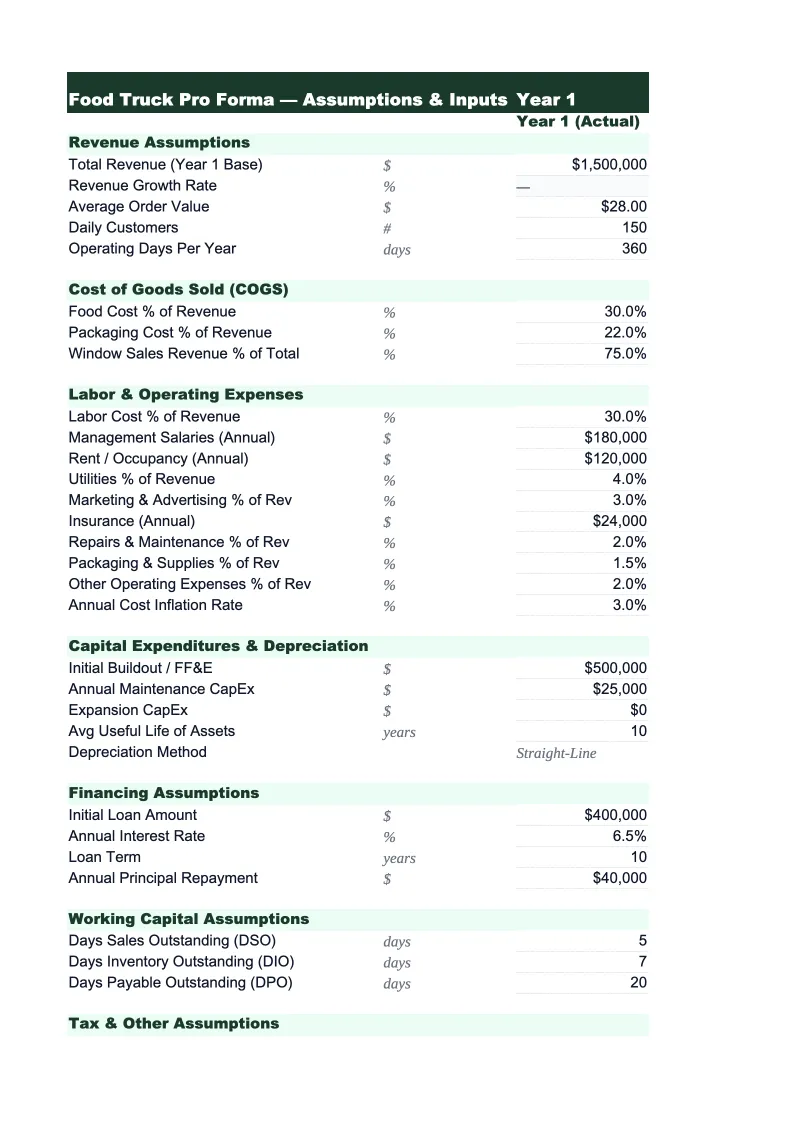
Assumptions
The control panel for the entire model.
Revenue Projections
Projects total food truck revenue by month for year one and annually through year five.
Operating Expenses
Breaks out all food truck operating costs into the categories that matter most for a mobile food business.
Startup Costs
A dedicated worksheet for estimating the total investment required to launch a food truck.
5-Year P&L Summary
An annual summary showing total revenue, food cost (COGS), gross profit, commissary and vehicle costs, labor, other operating expenses, EBITDA, and net income for each of the five projected years side by side.
Break-Even Analysis
Calculates the minimum service days per month and daily revenue your food truck needs to cover all fixed and variable costs.
Food Truck Pro Forma Template Features
- Service day and average ticket model with seasonal adjustments and ramp-up schedule
- Revenue split across street service, events/festivals, and private catering
- Commissary fees and fuel tracked separately from food COGS with % of revenue benchmarks
- Startup costs tracker with budgeted vs. actual for truck, equipment, and permits
- 5-year annual P&L summary with EBITDA and net margin by year
- Break-even analysis by service days per month and daily revenue needed
How to Use This Food Truck Pro Forma Spreadsheet
Start with the Assumptions sheet. Enter your planned service days per week, target daily revenue, and how many catering or private events you expect per month — these inputs drive the entire revenue model. If you're launching a new truck, set a conservative ramp schedule: most new food trucks generate 40–60% of their target daily revenue in the first three months as they establish routes and build a regular customer base. Spend 30 minutes calibrating these assumptions before reviewing any outputs; getting them right is the most valuable work you'll do with the model.
Once assumptions are in, review the Revenue Projections and Operating Expenses sheets to make sure the categories match your operation. A truck that runs primarily on corporate lunch routes has a different cost structure than one that does mostly weekend festivals — adjust the revenue mix, seasonal factors, and commissary costs to reflect your actual setup. Use the Startup Costs sheet to build your investment estimate as truck quotes and equipment bids come in; the total feeds directly into the break-even calculation.
From download to lender-ready projections in under an hour
Enter your service days, average ticket, and catering bookings — the model builds your 5-year revenue, commissary costs, and break-even analysis automatically.
Why Every Food Truck Launch Needs a Pro Forma
A food truck pro forma is the document that separates operators who understand their unit economics from those guessing at them. For SBA microloans (the most common financing vehicle for food trucks), lenders want to see realistic food cost targets, a plausible ramp-up, and a clear picture of how the truck generates enough gross profit to service debt. For truck financing companies, the pro forma shows that the business can generate enough cash flow to cover the loan payment on the vehicle. And for any equity partners, it answers the basic question: what does this look like at scale, and when does the investment pay back?
The numbers that define food truck profitability are slightly different from a brick-and-mortar restaurant. Gross margin targets are typically higher — food trucks aim for 60–70% gross margin because they have no rent, no FOH labor, and simpler menus. But commissary kitchen fees (usually $400–$1,500 per month depending on market) and fuel and vehicle costs (often $800–$2,000 per month for an active truck) eat into that margin in ways that don't show up in restaurant models. A food truck that runs a 65% gross margin but spends 12% of revenue on commissary and fuel is structurally different from one that runs the same gross margin but operates out of a shared commercial kitchen for $500 per month. Your pro forma needs to model these fixed costs explicitly.
Food Truck Industry at a Glance
Financial templates built for food truck operators — from single-unit street vendors to multi-truck fleets. Pre-loaded with commissary fees, fuel costs, permit categories, and event-based revenue tracking.
Revenue Drivers
- Street service (lunch/dinner stops)
- Private catering events
- Corporate events
- Food truck rallies and festivals
Key Cost Categories
- Food costs (COGS)
- Commissary kitchen fees
- Fuel and vehicle maintenance
- Permits and licenses
- Labor
- Payment processing and POS fees
Typical Margins
Gross: 60-70% · Net: 6-15%
Seasonality
Peak revenue in spring and summer; heavily weather-dependent. Winter months significantly slower in northern climates. Event catering provides revenue stability year-round.
Key Performance Indicators
Food Truck Pro Forma Template FAQ
More Food Truck Templates
Food Truck Balance Sheet Template for Excel
$29
Food Truck Budget Template for Excel
$29
Food Truck Business Plan Template for Excel
$39
Food Truck Cash Flow Template for Excel
$29
Food Truck Expense Tracker Template for Excel
$29
Food Truck Financial Model Template for Excel
$29
Food Truck Income Statement Template for Excel
$29
Food Truck Invoice Template for Excel
$29
Food Truck KPI Dashboard Template for Excel
$29
Food Truck P&L Template for Excel
$29
Food Truck Project Budget Template for Excel
$29
Food Truck Sales Forecast Template for Excel
$29
Food Truck Valuation Template for Excel
$29
Food Truck Pro Forma Template
$29