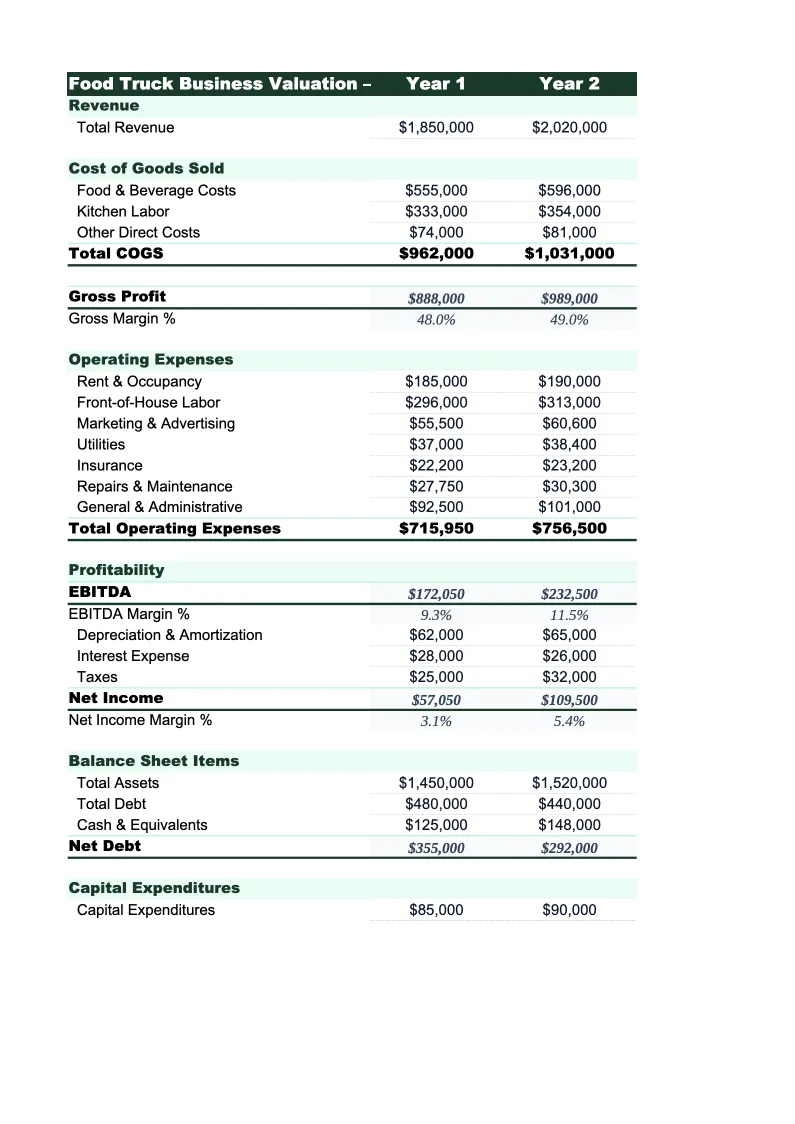
Food Truck Valuation Template
Value your food truck using SDE multiples, asset-based approach, and a value drivers scorecard — with benchmarks built around how mobile food businesses actually sell.
What's Inside This Food Truck Valuation Template
This template includes 6 worksheets, each designed for a specific part of your food truck financial workflow:
Business Inputs
The foundation of the entire valuation model.
SDE Multiple Approach
The primary valuation method for owner-operated food trucks.
Asset-Based Valuation
Calculates the tangible asset floor of your food truck business — the minimum value below which any rational seller should not transact.
Revenue Multiple Check
A secondary validation method using revenue multiples, which buyers and brokers commonly use as a quick sanity check in food truck transactions.
Value Drivers Scorecard
A structured scoring model for the qualitative factors that push a food truck's multiple toward the top or bottom of its range.
Valuation Summary
A single-page output consolidating all methods into one view across conservative, base, and optimistic scenarios.
Food Truck Valuation Template Features
- SDE calculation with owner compensation normalization and non-recurring expense add-backs
- Asset inventory sheet covering truck fair market value, cooking equipment, and permits
- Revenue multiple cross-check calibrated to 0.2–0.75x gross revenue market range
- Value drivers scorecard scoring truck condition, event contracts, and owner-dependency
- Multiple selection matrix mapping your operational profile to a defensible SDE multiple
- Three-scenario valuation summary with sensitivity table across SDE multiple increments
How to Use This Food Truck Valuation Spreadsheet
Start with the Business Inputs sheet. Pull your trailing twelve-month revenue from your POS system or bank deposits, broken down by revenue channel if possible — street service revenue behaves differently than event catering when buyers evaluate stability. You'll also need your annual expense breakdown (food costs, commissary, fuel, permits, labor, insurance), owner compensation including any draws or personal expenses run through the business, and a rough estimate of your truck and major equipment's current market value. If you don't know the truck's current market value, check current listings for comparable truck builds on used commercial equipment sites to get a realistic number — book value is not what buyers will pay.
Work through the SDE Multiple Approach next, which is the core of any food truck sale. The normalization step is the most important: you're separating what you earn as the working owner from what a replacement operator would cost to run the truck day-to-day. If you're working 60 hours a week and paying yourself $60,000, but a replacement operator would cost $45,000, your SDE normalization should reflect that. Then complete the Value Drivers Scorecard honestly — truck condition, event contract backlog, social following, and how easily the business runs without you personally are the factors that most affect where buyers land within the multiple range. Most owner-operators score low on replaceability, which is normal but also the single biggest value lever you can pull before selling.
Know what your food truck is worth before you list it
Enter your revenue, expenses, and truck details — and get a defensible valuation range with the SDE multiple, asset floor, and value drivers that buyers will use to make their offer.
How Food Trucks Are Valued When They Sell
Food truck valuations are simpler than most business sales because the variables are fewer — but buyers and brokers still follow a structured process, and understanding it before you list is the difference between getting your number and leaving $50,000 on the table. Most food truck sales use SDE multiples as the primary method, with the physical truck and equipment value setting a hard floor. A profitable food truck generating $80,000 in annual SDE might sell for $140,000–200,000 depending on truck condition, event contract backlog, and how easily the business can run without the current owner. Unprofitable or breakeven trucks often sell near asset value — buyers are effectively paying for the equipment, permits, and brand, not future earnings.
The two factors that most separate a $120,000 truck sale from a $250,000 one are booked event contracts and demonstrated owner-replaceability. Buyers pay a premium for event catering contracts that transfer with the sale — a truck with $60,000 in signed future event bookings transfers revenue certainty that a street-only operation can't offer. Owner-replaceability matters because most buyers are not culinary operators themselves; they're acquiring a business they plan to staff. A truck with documented recipes, established supplier relationships, trained part-time staff, and a social media account with 8,000 followers is fundamentally easier for a new owner to operate than one where the owner personally runs every service and carries the menu in their head. These factors are captured in the value drivers scorecard and directly affect which multiple the buyer is willing to apply.
Food Truck Industry at a Glance
Financial templates built for food truck operators — from single-unit street vendors to multi-truck fleets. Pre-loaded with commissary fees, fuel costs, permit categories, and event-based revenue tracking.
Revenue Drivers
- Street service (lunch/dinner stops)
- Private catering events
- Corporate events
- Food truck rallies and festivals
Key Cost Categories
- Food costs (COGS)
- Commissary kitchen fees
- Fuel and vehicle maintenance
- Permits and licenses
- Labor
- Payment processing and POS fees
Typical Margins
Gross: 60-70% · Net: 6-15%
Seasonality
Peak revenue in spring and summer; heavily weather-dependent. Winter months significantly slower in northern climates. Event catering provides revenue stability year-round.
Key Performance Indicators
Food Truck Valuation FAQ
More Food Truck Templates
Food Truck Balance Sheet Template for Excel
$29
Food Truck Budget Template for Excel
$29
Food Truck Business Plan Template for Excel
$39
Food Truck Cash Flow Template for Excel
$29
Food Truck Expense Tracker Template for Excel
$29
Food Truck Financial Model Template for Excel
$29
Food Truck Income Statement Template for Excel
$29
Food Truck Invoice Template for Excel
$29
Food Truck KPI Dashboard Template for Excel
$29
Food Truck P&L Template for Excel
$29
Food Truck Pro Forma Template for Excel
$29
Food Truck Project Budget Template for Excel
$29
Food Truck Sales Forecast Template for Excel
$29
Food Truck Valuation Template
$29