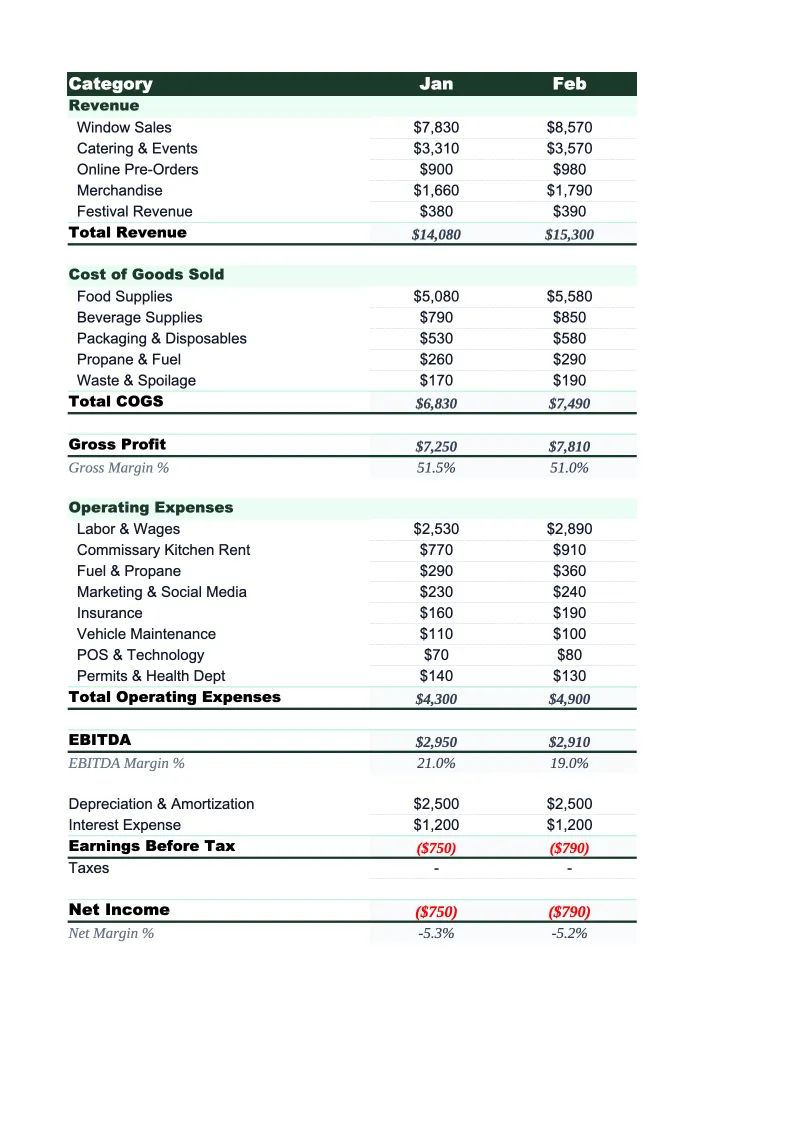
Food Truck P&L Template
Track your food truck's revenue, food costs, commissary fees, and net income with a P&L template built for mobile food vendors — not a generic spreadsheet you have to rebuild from scratch.
What's Inside This Food Truck P&L Template
This template includes 4 worksheets, each designed for a specific part of your food truck financial workflow:
Monthly P&L
The main worksheet where you record each month's revenue and expenses.
Annual P&L
A 12-month view that pulls from the Monthly P&L sheet automatically.
Service Day Tracker
A worksheet for tracking performance at the unit level.
Dashboard
A one-page visual summary with pre-built charts and key financial metrics.
Food Truck P&L Template Features
- Revenue split by channel: street service, catering, corporate events, and rallies
- Commissary kitchen fees tracked as a dedicated operating expense line
- Fuel and vehicle maintenance separated from other operating costs
- Food cost percentage auto-calculated against revenue each month
- Service day tracker to monitor revenue per stop and average ticket
- 12-month annual P&L view with full-year totals and trend data
How to Use This Food Truck P&L Spreadsheet
Download the .xlsx file and open it in Excel or Google Sheets — no macros, no plugins required. Start with the Monthly P&L sheet and review the pre-loaded revenue and expense categories. Most food truck operators can use 80–90% of them without changes. If you don't do private catering, remove that line. If you have multiple trucks, add a revenue row per unit. The first-time setup typically takes 15–20 minutes.
Once the structure fits your operation, enter your monthly revenue and expense figures. Pull revenue from your POS system's monthly report and expenses from your bank statements or accounting software. The Service Day Tracker is worth filling out in parallel: log each location, transaction count, and gross revenue as you go through the month. By month-end you'll have clean data on which stops are profitable and which aren't — information that most food truck owners track in their heads but rarely write down.
15 minutes from download to your first P&L
Download the template, enter last month's numbers, and see your food truck's gross margin and net income — with food cost percentage and service day performance calculated automatically.
Why Every Food Truck Needs a P&L Template
Food trucks operate in a business model that looks simple from the outside but has more cost complexity than most small food businesses. Net margins typically run 6–15%, which sounds acceptable until you account for the variables: food costs move with ingredient prices, commissary fees are fixed regardless of revenue, fuel costs vary with how far you travel, and a single slow week can flip a profitable month. Most food truck owners manage these numbers informally — checking their bank account rather than reading a P&L — which means problems show up late.
A food truck P&L has cost categories that generic templates simply don't include. Commissary kitchen fees are one of the biggest operating expenses for most operators, but a standard small business template lumps it under 'rent' or ignores it entirely. Fuel and vehicle maintenance are another category that behaves differently from typical business expenses — they're partly variable (tied to how many stops you run) and partly unpredictable (a repair can cost $3,000 in a week with no warning). Permits and licenses renew on different schedules across jurisdictions. When these are tracked separately, your P&L tells you exactly what it costs to operate your truck, not just how much you spent.
Food Truck Industry at a Glance
Financial templates built for food truck operators — from single-unit street vendors to multi-truck fleets. Pre-loaded with commissary fees, fuel costs, permit categories, and event-based revenue tracking.
Revenue Drivers
- Street service (lunch/dinner stops)
- Private catering events
- Corporate events
- Food truck rallies and festivals
Key Cost Categories
- Food costs (COGS)
- Commissary kitchen fees
- Fuel and vehicle maintenance
- Permits and licenses
- Labor
- Payment processing and POS fees
Typical Margins
Gross: 60-70% · Net: 6-15%
Seasonality
Peak revenue in spring and summer; heavily weather-dependent. Winter months significantly slower in northern climates. Event catering provides revenue stability year-round.
Key Performance Indicators
Food Truck P&L Template FAQ
More Food Truck Templates
Food Truck Balance Sheet Template for Excel
$29
Food Truck Budget Template for Excel
$29
Food Truck Business Plan Template for Excel
$39
Food Truck Cash Flow Template for Excel
$29
Food Truck Expense Tracker Template for Excel
$29
Food Truck Financial Model Template for Excel
$29
Food Truck Income Statement Template for Excel
$29
Food Truck Invoice Template for Excel
$29
Food Truck KPI Dashboard Template for Excel
$29
Food Truck Pro Forma Template for Excel
$29
Food Truck Project Budget Template for Excel
$29
Food Truck Sales Forecast Template for Excel
$29
Food Truck Valuation Template for Excel
$29
Food Truck P&L Template
$29