Pest Control Business Plan Template
Build a complete financial roadmap for your pest control business with startup costs, service call assumptions, and 3-year P&L projections — pre-built for residential, commercial, and specialized pest services.
What's Inside This Pest Control Business Plan Template
This template includes 5 worksheets, each designed for a specific part of your pest control financial workflow:
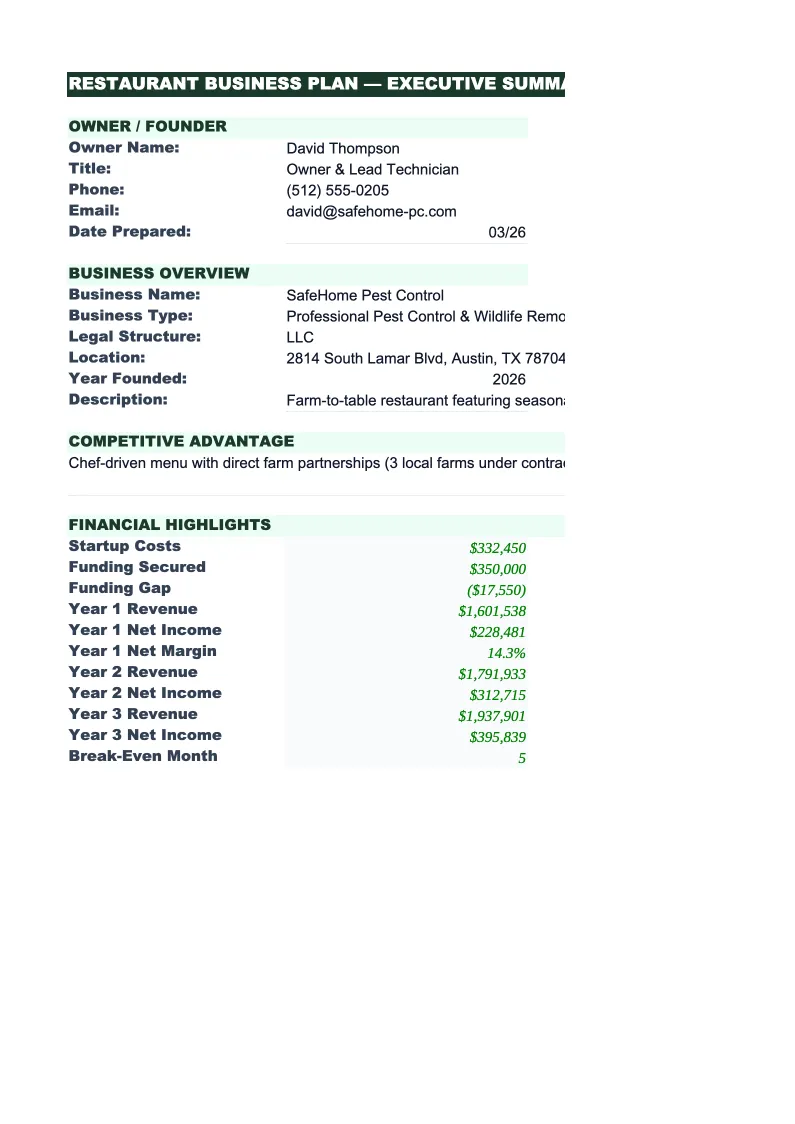
Executive Summary
A one-page overview of your pest control business showing your service offerings (residential, commercial, specialized treatments), target market, and key financial metrics.
Startup Costs & Funding
A detailed tracker for your initial investment including vehicle purchase or lease (the largest expense), equipment and tools (sprayers, vacuums, traps, diagnostic tools), licensing and certifications (state pest control licenses typically $500–$5,000), insurance (liability and vehicle), initial inventory of chemicals and treatments, office setup, and working capital.
Revenue Forecast
Projects monthly revenue based on number of service calls per month, average service fee, and recurring contract revenue.
Projected P&L
Annual and monthly profit & loss statement showing revenue, cost of goods sold (chemicals, equipment depreciation, vehicle fuel and maintenance), gross profit, and operating expenses (licensing/permits, insurance, office staff, marketing, dispatch software, continuing education, vehicle payment).
Dashboard
A visual overview of key metrics including total revenue, profit, service calls per month, average revenue per call, gross margin, break-even analysis, and profitability timeline.
Pest Control Business Plan Features
- Startup costs for vehicle, equipment, licensing, insurance, and working capital
- Revenue model based on service calls, recurring contracts, and service mix
- Recurring revenue assumptions—most pest control is 70%+ contracts (monthly or quarterly)
- Gross margin tracking including chemicals, equipment, and vehicle costs
- 3-year P&L with EBITDA and net margin showing path to profitability
- Break-even analysis showing service call volume and fees needed to cover fixed costs
How to Use This Business Plan Spreadsheet
Start with the Startup Costs sheet and list every expense: vehicle (lease or purchase—budget $30,000–$50,000 for a work truck), equipment (sprayers, vacuums, diagnostic tools, safety gear—$3,000–$8,000), licensing and certifications (varies by state—$500–$5,000), insurance (liability and commercial vehicle—$3,000–$6,000/year), initial chemical inventory ($2,000–$5,000), office setup, and 3 months working capital. Most pest control startups need $35,000–$75,000 total. Determine if you'll buy a vehicle (higher startup cost, you own it) or lease (lower startup, ongoing payments). Run both scenarios and compare total cost of ownership over 3 years.
Move to the Revenue Forecast sheet and set your assumptions: how many service calls per week you can realistically handle in month one (3–5), how you'll ramp to mature capacity (15–30 per week by month 12), and your average revenue per call by service type. Residential pest control typically runs $150–$300 per one-time treatment or $40–$100 monthly for recurring contracts; commercial properties $300–$1,000+ depending on size. Most pest control revenue is recurring contracts (70–80%), so model monthly/quarterly repeat revenue separately from one-time calls. Once you set these assumptions, revenue builds automatically based on your capacity.
From launch to investor-ready business plan in one sitting
Enter your startup costs, vehicle choice, average service fee, and call targets—the model projects your 3-year revenue, profitability, and cash runway automatically.
Why Pest Control Businesses Need a Business Plan
Pest control is a high-margin service business with recurring revenue, making it attractive for entrepreneurs. Your profitability depends on four factors: call volume (number of service calls per month), average revenue per call, gross margin on treatments (typically 60–70%), and fixed costs (vehicle, licensing, insurance, staff). A pest control technician can realistically handle 15–30 calls per week depending on the type of work (fast one-off treatments vs. complex commercial accounts). If you start solo, your capacity is limited by your time. Most pest control operators add a second technician when they're consistently booking 20–25+ calls per week and can't handle more alone.
The vehicle is your largest startup cost and your biggest monthly expense. A commercial pest control vehicle costs $30,000–$50,000 new or $15,000–$30,000 used, plus insurance ($3,000–$5,000/year), fuel ($200–$400/month), and maintenance ($100–$200/month). Your business plan must account for this: if you finance the vehicle at $500/month for 5 years plus $300 insurance plus $300 fuel/maintenance, that's $1,100/month in vehicle costs alone before you pay yourself. You need to generate $200–$300 in revenue per call just to cover vehicle costs, so position your pricing accordingly. Calculate your break-even: at $200/call average and 20 calls/week, you generate $4,000/week or $16,000/month—which covers vehicle costs plus operating expenses and starts building profit.
Pest Control Industry at a Glance
Financial templates built for pest control businesses — from solo operators to multi-route companies. Pre-loaded with recurring contract, termite, and specialty treatment categories.
Revenue Drivers
- Recurring GPP contracts
- Termite treatments and monitoring
- Bed bug and specialty treatments
- Rodent control and exclusion
- Mosquito and tick programs
- Commercial pest control contracts
Key Cost Categories
- Technician wages and payroll taxes
- Pesticides, rodenticides, and materials
- Vehicle fuel and fleet maintenance
- Liability and commercial auto insurance
- Pesticide applicator license fees
- Route management and CRM software
Typical Margins
Gross: 45-60% · Net: 10-20%
Seasonality
Spring through fall drives new contract sign-ups and mosquito/tick program revenue; core GPP and commercial contracts provide year-round base revenue; termite swarm season (March–June) is a major driver of new termite treatment sales.
Key Performance Indicators
Pest Control Business Plan FAQ
More Pest Control Templates
Pest Control Balance Sheet Template for Excel
$29
Pest Control Budget Template for Excel
$29
Pest Control Cash Flow Template for Excel
$29
Pest Control Expense Tracker Template for Excel
$29
Pest Control Financial Model Template for Excel
$29
Pest Control Income Statement Template for Excel
$29
Pest Control Invoice Template for Excel
$29
Pest Control KPI Dashboard Template for Excel
$29
Pest Control P&L Template for Excel
$29
Pest Control Pro Forma Template for Excel
$29
Pest Control Project Budget Template for Excel
$29
Pest Control Sales Forecast Template for Excel
$29
Pest Control Business Valuation Template for Excel
$29
More Business Plan Templates
Pest Control Business Plan Template
$39