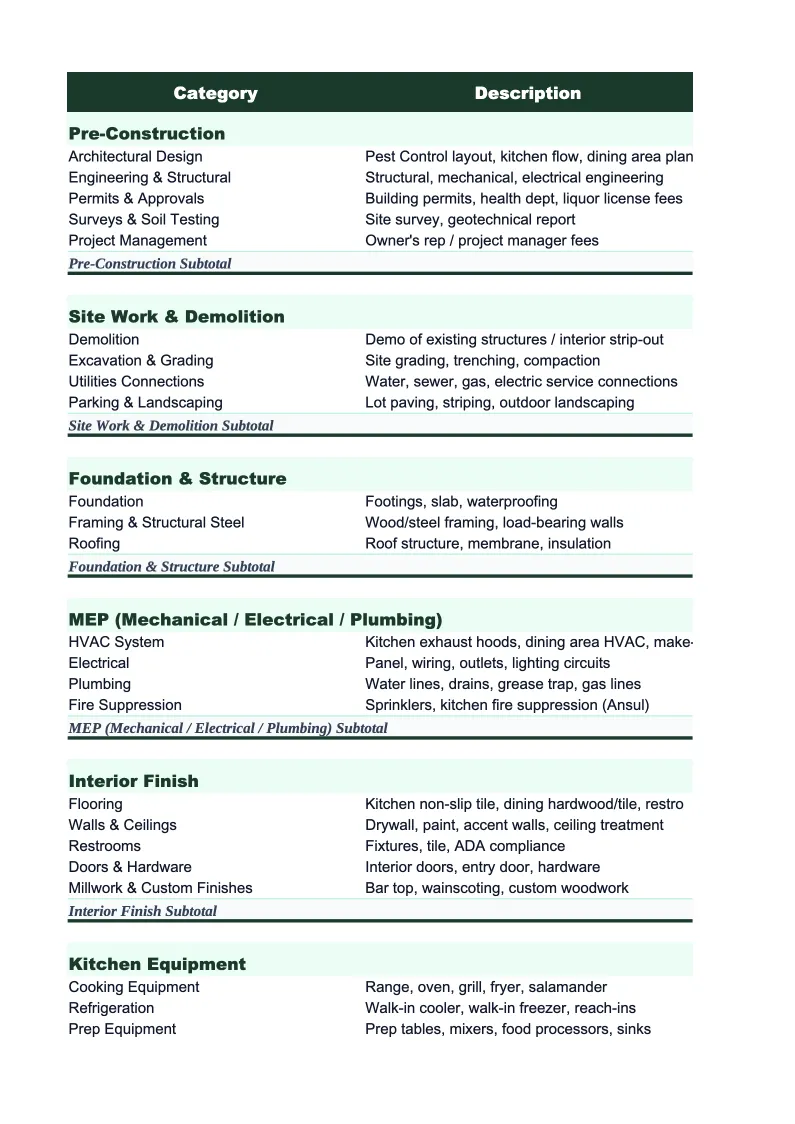
Pest Control Project Budget Template
Plan and track every cost of growing your pest control business — new service vehicles, treatment equipment, licensing, and technology — with estimated vs actual tracking built in.
What's Inside This Pest Control Project Budget Template
This template includes 6 worksheets, each designed for a specific part of your pest control financial workflow:
Project Summary
A top-level view of the entire capital project — whether you're adding a service route, launching a termite division, purchasing heat treatment equipment, or opening a second branch location.
Fleet & Equipment
Tracks all vehicle and field equipment costs for the project.
Licensing & Compliance
Covers every regulatory and compliance cost required to operate legally in a new market or with a new service line.
Technology & Systems
Captures every technology cost required to support the expanded operation.
Marketing & Launch
Tracks the upfront marketing and customer acquisition costs needed to get a new route or market to breakeven.
Budget vs Actual
A consolidated summary that pulls estimated and actual cost totals from every category sheet and calculates dollar and percentage variance for each.
Pest Control Project Budget Template Features
- Fleet and equipment tracker with service van, spray equipment, and PPE line items
- Licensing and compliance budget with per-technician license fees, bonds, and insurance deposits
- Technology systems tracker with route software, GPS, and field device costs
- Marketing and launch budget with direct mail, door hangers, and digital advertising line items
- Estimated vs actual variance tracking with color-coded overrun flagging
- Project summary dashboard with committed spend and remaining budget in one view
How to Use This Pest Control Project Budget Spreadsheet
Start by opening the Project Summary sheet and entering your project type — new route launch, service line addition, fleet expansion, or second branch — along with your target go-live date and total budget. This sheet anchors the template: it pulls totals from the Fleet, Licensing, Technology, and Marketing sheets automatically so you see your full cost position without manual calculations. Then open each category sheet and work through the pre-loaded line items. Rename or remove anything that doesn't apply to your project and add rows for costs specific to your situation, such as a heat treatment unit if you're launching a bed bug division or a fumigation tent inventory if adding tent fumigation.
As you collect quotes and place orders, enter actual costs and vendor details alongside the estimates. The Budget vs Actual sheet updates in real time and flags categories where actuals are running ahead of plan. Pest control project budgets frequently hit surprises in licensing — a new state may require each technician to sit for a separate applicator exam, or a commercial pest control bond requirement may be higher than expected for your license class. Catching a $1,500 licensing overage during the planning phase is a simple adjustment; discovering it after you've already committed the equipment budget creates a cash shortfall right when you need capital for vehicle deposits.
15 minutes from download to your first project budget
Download the template, enter your project scope, and see your full cost picture — fleet, licensing, technology, and marketing costs tracked in one place.
Why Pest Control Companies Need a Project Budget Template
Growing a pest control company is primarily a route economics problem. Every technician you add increases your recurring monthly revenue potential, but also increases fixed costs — a vehicle, insurance, license fees, and route management software seats — that you carry regardless of how many accounts that technician is running. Operators who track project costs rigorously know exactly what it costs to put a new technician on the road, how many recurring GPP accounts that technician needs to cover the fixed cost base, and what the payback period looks like at your average contract value. Operators who don't track these costs often discover their new route isn't cash-flow positive until month eight or nine, which creates a working capital squeeze that was entirely predictable.
The cost categories that matter most in a pest control project budget are the ones that get overlooked most often. The service van is the visible line item, but the full cost to bring a technician into service includes chemical tank installation, initial pesticide and material inventory, personal protective equipment, state applicator license fees, the incremental insurance premium on the added vehicle and employee, and the software seat for route management. Compliance costs deserve their own sheet because they're both non-negotiable and variable by state — some markets require fumigation endorsements, structural pest control bond amounts vary significantly, and DOT registration requirements apply in states that didn't require them in your current market. Skipping the compliance sheet in a budget is how operators end up with a van sitting in the yard for three weeks while licensing paperwork clears.
Pest Control Industry at a Glance
Financial templates built for pest control businesses — from solo operators to multi-route companies. Pre-loaded with recurring contract, termite, and specialty treatment categories.
Revenue Drivers
- Recurring GPP contracts
- Termite treatments and monitoring
- Bed bug and specialty treatments
- Rodent control and exclusion
- Mosquito and tick programs
- Commercial pest control contracts
Key Cost Categories
- Technician wages and payroll taxes
- Pesticides, rodenticides, and materials
- Vehicle fuel and fleet maintenance
- Liability and commercial auto insurance
- Pesticide applicator license fees
- Route management and CRM software
Typical Margins
Gross: 45-60% · Net: 10-20%
Seasonality
Spring through fall drives new contract sign-ups and mosquito/tick program revenue; core GPP and commercial contracts provide year-round base revenue; termite swarm season (March–June) is a major driver of new termite treatment sales.
Key Performance Indicators
Pest Control Project Budget Template FAQ
More Pest Control Templates
Pest Control Balance Sheet Template for Excel
$29
Pest Control Budget Template for Excel
$29
Pest Control Business Plan Template for Excel
$39
Pest Control Cash Flow Template for Excel
$29
Pest Control Expense Tracker Template for Excel
$29
Pest Control Financial Model Template for Excel
$29
Pest Control Income Statement Template for Excel
$29
Pest Control Invoice Template for Excel
$29
Pest Control KPI Dashboard Template for Excel
$29
Pest Control P&L Template for Excel
$29
Pest Control Pro Forma Template for Excel
$29
Pest Control Sales Forecast Template for Excel
$29
Pest Control Business Valuation Template for Excel
$29
More Project Budget Templates
Pest Control Project Budget Template
$29