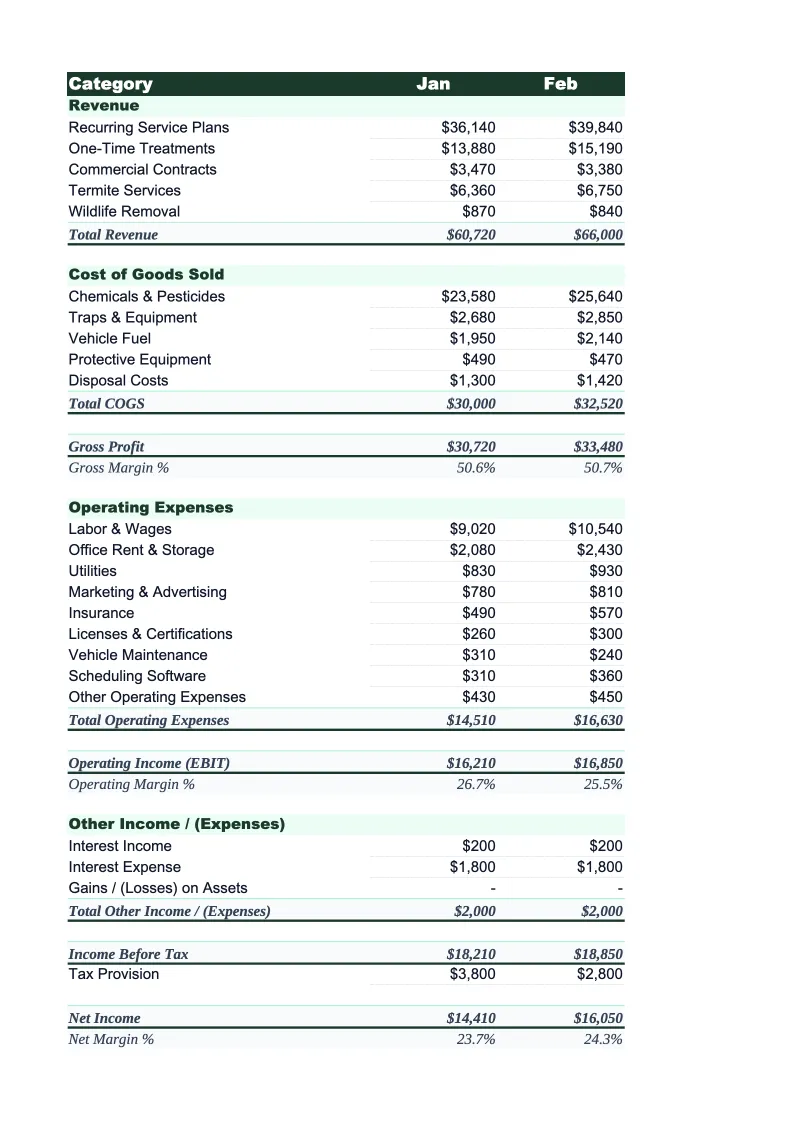
Pest Control Income Statement Template
Report your pest control company's revenue by service type — recurring contracts, termite treatments, specialty services — and see gross and net margins in a structured income statement built for the industry.
What's Inside This Pest Control Income Statement Template
This template includes 4 worksheets, each designed for a specific part of your pest control financial workflow:
Monthly Income Statement
The core worksheet where you record monthly revenue and expenses in a standard income statement format.
Annual Summary
A 12-month income statement that pulls from each monthly sheet automatically.
Margin Analysis
A dedicated sheet that calculates the key margin ratios and operational metrics your pest control company should track every month.
Dashboard
A visual summary with pre-built charts showing revenue by service type, gross and net margin trends by month, expense breakdown as a percentage of revenue, and year-to-date totals.
Pest Control Income Statement Template Features
- Revenue split by recurring GPP contracts, termite treatments, specialty services, rodent control, and commercial accounts
- COGS separated into pesticide/material costs and technician labor
- Gross profit, operating income, and net income auto-calculations
- Recurring monthly revenue (RMR) and revenue per technician per day tracking
- 12-month annual summary with seasonal performance visibility
- Visual dashboard with revenue mix and margin trend charts
How to Use This Pest Control Income Statement Spreadsheet
Getting started takes about 15 minutes. Download the .xlsx file and open it in Excel or Google Sheets — no macros or plugins required. Start with the Monthly Income Statement sheet and review the pre-loaded revenue and expense categories. Most pest control operators will keep the structure as-is; if you don't offer mosquito programs or don't separate termite monitoring from termite treatments, adjust those rows to match how your business is organized. The formulas reference full column ranges, so removing unused categories won't break the gross profit or net income calculations.
Once the structure looks right, enter last month's figures as your starting point. Pull revenue by service category from your route management or CRM software — most platforms like PestPac, ServicePro, or FieldRoutes can export a monthly revenue summary by service type. Enter your pesticide and material costs from supplier invoices, technician wages from your payroll report, and operating expenses from your bank statement. The sheet handles the math. Repeat this each month going forward and the Annual Summary sheet updates automatically.
15 minutes from download to your first income statement
Download the template, plug in your service revenue and cost figures, and see your pest control company's gross margin, recurring revenue, and net income laid out clearly — all in one spreadsheet.
Why Every Pest Control Company Needs an Income Statement Template
Pest control company finances hinge on one distinction that a generic income statement almost always misses: the split between recurring contract revenue and one-time treatment revenue. GPP contracts and commercial accounts generate predictable monthly cash flow and are the core of any company's valuation. Termite treatments, bed bug jobs, and specialty services are higher-ticket but variable. When these two streams are lumped together under 'service revenue,' you can't see whether your recurring base is growing, whether one-time work is masking a stagnant contract book, or whether a bad termite season is actually hurting your annual numbers.
The income statement categories that matter most for a pest control business are: recurring GPP and commercial revenue (your RMR base), termite treatment revenue (highly seasonal, March–June swarm season), specialty service revenue (bed bugs, rodents, mosquito/tick programs), pesticide and material costs as a percentage of each revenue stream, and technician labor as a direct cost. Industry benchmarks suggest gross margins of 45–60% are achievable for well-run operators, with net margins landing between 10–20% depending on fleet size, geographic density, and whether the owner draws a market-rate salary. Companies below 10% net margin are typically carrying underutilized routes, paying above-market for materials, or not pricing new services to cover their labor cost fully.
Pest Control Industry at a Glance
Financial templates built for pest control businesses — from solo operators to multi-route companies. Pre-loaded with recurring contract, termite, and specialty treatment categories.
Revenue Drivers
- Recurring GPP contracts
- Termite treatments and monitoring
- Bed bug and specialty treatments
- Rodent control and exclusion
- Mosquito and tick programs
- Commercial pest control contracts
Key Cost Categories
- Technician wages and payroll taxes
- Pesticides, rodenticides, and materials
- Vehicle fuel and fleet maintenance
- Liability and commercial auto insurance
- Pesticide applicator license fees
- Route management and CRM software
Typical Margins
Gross: 45-60% · Net: 10-20%
Seasonality
Spring through fall drives new contract sign-ups and mosquito/tick program revenue; core GPP and commercial contracts provide year-round base revenue; termite swarm season (March–June) is a major driver of new termite treatment sales.
Key Performance Indicators
Pest Control Income Statement Template FAQ
More Pest Control Templates
Pest Control Balance Sheet Template for Excel
$29
Pest Control Budget Template for Excel
$29
Pest Control Business Plan Template for Excel
$39
Pest Control Cash Flow Template for Excel
$29
Pest Control Expense Tracker Template for Excel
$29
Pest Control Financial Model Template for Excel
$29
Pest Control Invoice Template for Excel
$29
Pest Control KPI Dashboard Template for Excel
$29
Pest Control P&L Template for Excel
$29
Pest Control Pro Forma Template for Excel
$29
Pest Control Project Budget Template for Excel
$29
Pest Control Sales Forecast Template for Excel
$29
Pest Control Business Valuation Template for Excel
$29
More Income Statement Templates
Accounting Firm Income Statement Template for Excel
$29
Auto Repair Income Statement Template for Excel
$29
Car Wash Income Statement Template for Excel
$29
Church Income Statement Template for Excel
$29
Cleaning Service Income Statement Template for Excel
$29
Coffee Shop Income Statement Template for Excel
$29
Pest Control Income Statement Template
$29