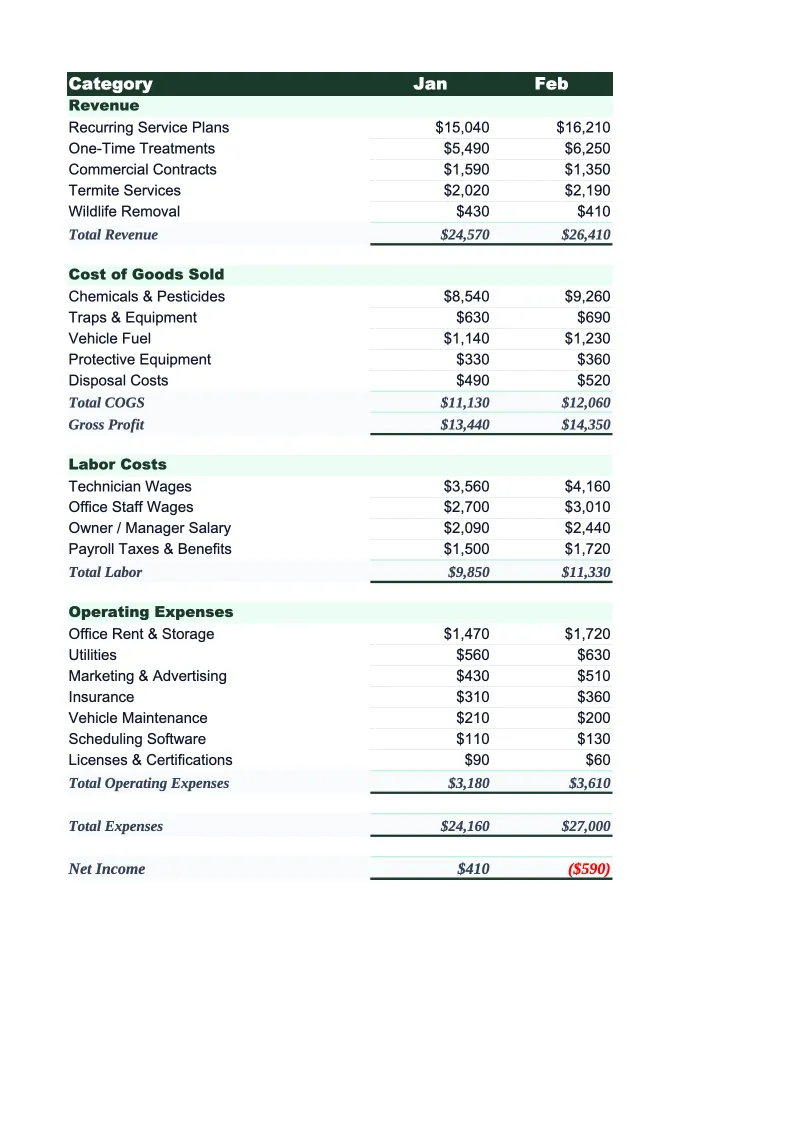
Pest Control Budget Template
Plan and track your pest control company's finances with a budget template built for the industry — recurring contracts, seasonal service lines, chemical costs, and fleet expenses all pre-loaded.
What's Inside This Pest Control Budget Template
This template includes 4 worksheets, each designed for a specific part of your pest control financial workflow:
Monthly Budget
The core planning worksheet where you map out each month's projected revenue and expenses using pest control-specific categories.
Annual Summary
A 12-month rollup that pulls revenue and expense data from each monthly sheet automatically, giving you a full-year view of the business without manually combining anything.
Budget vs Actual
Enter your actual monthly figures alongside your planned budget and the sheet calculates dollar and percentage variance for every line item.
Dashboard
A visual summary with pre-built charts covering recurring monthly revenue (RMR) trend, revenue by service line, expense breakdown, and gross margin percentage by month.
Pest Control Budget Template Features
- Revenue split by GPP contracts, termite, specialty treatments, and commercial accounts
- Chemical and pesticide cost tracking as a percentage of revenue
- Fleet and vehicle expense line items for multi-route operators
- Recurring monthly revenue (RMR) tracking built into the monthly sheet
- 12-month annual rollup with seasonality visible across the year
- Budget vs actual variance tracking with color-coded flags
How to Use This Pest Control Budget Spreadsheet
Download the .xlsx file and open it in Excel or Google Sheets — no macros or plugins needed. Start with the Monthly Budget sheet and review the pre-loaded service line categories. Most pest control operators keep the GPP, termite, rodent, and commercial lines as-is and rename or remove any that don't match their service mix. If you only do residential general pest, collapse the specialty lines; if you run a large mosquito program, you may want to split that out further. This takes about 10 minutes on first setup.
Once your categories are set, enter your projected revenue and expenses for the current month. If you're not sure where to start, use your last three months of bank statements and service reports as a baseline. Pay particular attention to your recurring contract revenue — this is the most predictable line and gives your budget a stable foundation. For seasonal lines like mosquito programs or termite swarm-season treatments, use last year's numbers or industry estimates as a starting point and adjust as the season unfolds.
15 minutes from download to your first budget
Download the template, plug in your service lines and cost categories, and see your pest control company's full financial picture — monthly plan, annual rollup, and variance tracking included.
Why Every Pest Control Company Needs a Budget Template
Pest control is a cash-efficient business at steady state — gross margins of 45–60% and a recurring revenue base from GPP contracts mean the economics look strong on paper. The challenge is that those margins depend on controlling chemical costs, managing fleet efficiently, and keeping technician productivity high. Without a budget that tracks these line items separately, it's easy for costs to drift upward in a good volume year and not notice until the net margin collapses to single digits.
A useful pest control budget separates recurring contract revenue from one-time treatment revenue, because they behave differently and deserve different planning assumptions. Recurring GPP revenue is largely predictable month to month — budget it based on your current account count and average revenue per account (ARPA), then model churn conservatively. Termite, bed bug, and mosquito revenues are seasonal and volume-sensitive; budget them based on last year's actuals adjusted for any capacity changes. On the cost side, chemicals and rodenticides are your biggest variable cost and tend to scale with service volume, while fleet and insurance costs are fixed regardless of how many jobs you run.
Pest Control Industry at a Glance
Financial templates built for pest control businesses — from solo operators to multi-route companies. Pre-loaded with recurring contract, termite, and specialty treatment categories.
Revenue Drivers
- Recurring GPP contracts
- Termite treatments and monitoring
- Bed bug and specialty treatments
- Rodent control and exclusion
- Mosquito and tick programs
- Commercial pest control contracts
Key Cost Categories
- Technician wages and payroll taxes
- Pesticides, rodenticides, and materials
- Vehicle fuel and fleet maintenance
- Liability and commercial auto insurance
- Pesticide applicator license fees
- Route management and CRM software
Typical Margins
Gross: 45-60% · Net: 10-20%
Seasonality
Spring through fall drives new contract sign-ups and mosquito/tick program revenue; core GPP and commercial contracts provide year-round base revenue; termite swarm season (March–June) is a major driver of new termite treatment sales.
Key Performance Indicators
Pest Control Budget Template FAQ
More Pest Control Templates
Pest Control Balance Sheet Template for Excel
$29
Pest Control Business Plan Template for Excel
$39
Pest Control Cash Flow Template for Excel
$29
Pest Control Expense Tracker Template for Excel
$29
Pest Control Financial Model Template for Excel
$29
Pest Control Income Statement Template for Excel
$29
Pest Control Invoice Template for Excel
$29
Pest Control KPI Dashboard Template for Excel
$29
Pest Control P&L Template for Excel
$29
Pest Control Pro Forma Template for Excel
$29
Pest Control Project Budget Template for Excel
$29
Pest Control Sales Forecast Template for Excel
$29
Pest Control Business Valuation Template for Excel
$29
Pest Control Budget Template
$29