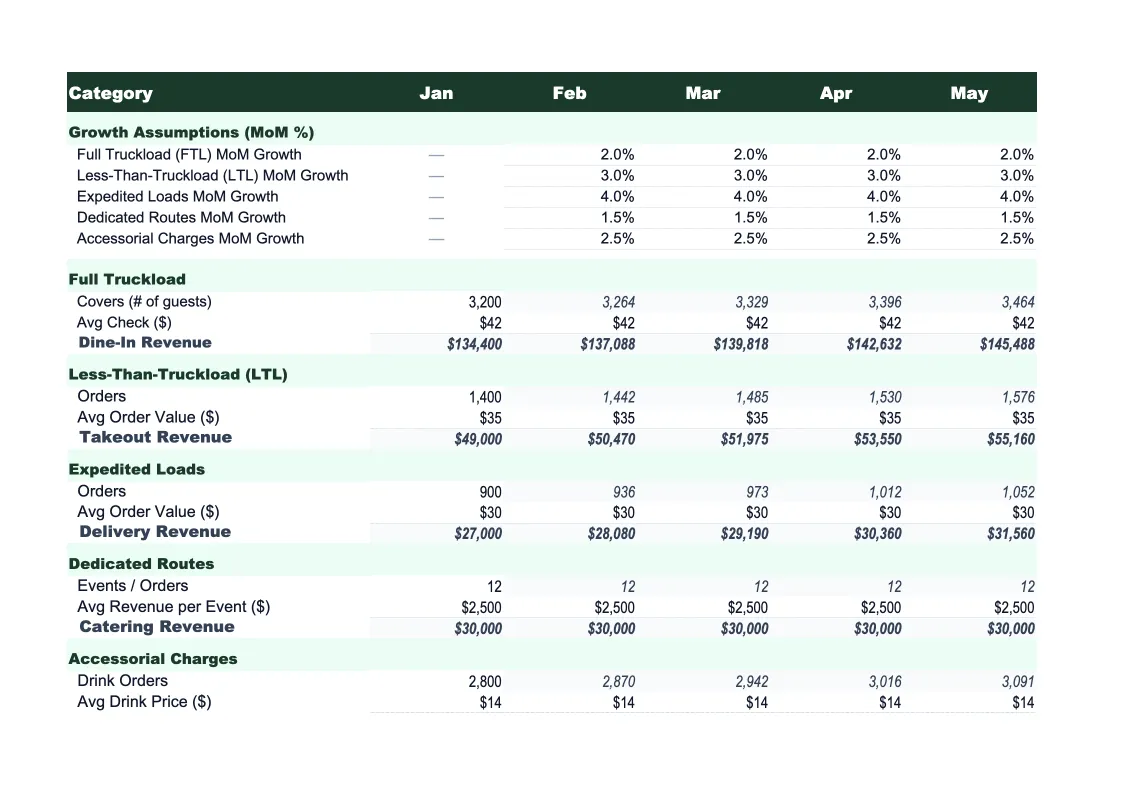
Trucking Sales Forecast Template
Forecast trucking revenue by lane, load count, and rate per mile — with fuel surcharge, accessorials, and seasonal adjustments built in.
What's Inside This Trucking Sales Forecast Template
This template includes 5 worksheets, each designed for a specific part of your trucking financial workflow:
Revenue Assumptions
The foundation of the forecast.
Monthly Forecast
Month-by-month revenue projections built from the assumptions sheet.
Actual vs Forecast
Track your actual revenue against what you projected, month by month.
Scenario Planning
Three side-by-side scenarios — base, upside, and downside — so you can pressure-test your forecast before committing to it.
Dashboard
A one-page summary of your forecast with charts for monthly revenue, revenue per mile trend, and actual-vs-forecast variance.
Trucking Sales Forecast Template Features
- Driver-based model: set loads, miles, and rate per mile — projections build from there
- Fuel surcharge and accessorial revenue tracked separately from linehaul
- Seasonal adjustment multipliers for Q4 peak and Q1 freight slowdowns
- Actual vs forecast variance tracking with color-coded alerts
- Three-scenario planning (base, upside, downside) with side-by-side comparison
- Revenue per mile (RPM) and load count metrics calculated automatically
How to Use This Trucking Sales Forecast Spreadsheet
Download the file and open it in Excel or Google Sheets — no macros required. Start on the Revenue Assumptions sheet and fill in your current operating numbers: how many trucks you're running, your average loads per week, typical loaded miles per trip, and your current linehaul rate per mile. If you have a fuel surcharge, enter the rate or dollar amount per mile. The Monthly Forecast sheet will populate immediately from those inputs, so you'll have a rough full-year projection within the first 15 minutes.
Once the base numbers look right, adjust the seasonality row in the Monthly Forecast sheet to match how your freight lanes actually move through the year. If you haul produce, your Q2 and Q3 might be your strongest months. If you run retail freight, Q4 is peak and January is slow. Adjust each month's multiplier up or down from 1.0 to reflect that pattern — the rest of the formulas handle the math. Then fill in the Scenario Planning sheet with your upside assumptions (getting that dedicated lane, adding a truck) and your downside assumptions (rate erosion, market softness).
15 minutes from download to your first trucking revenue forecast
Download the template, enter your loads and rate per mile, and see your full-year revenue projection — with scenarios and actual-vs-forecast tracking included.
Why Every Trucking Company Needs a Sales Forecast Template
Trucking revenue is deceptively simple on the surface — you move freight from A to B and get paid a rate per mile — but the actual P&L depends on a web of variables that move constantly. Spot rates swing with the freight market, fuel surcharge revenue changes weekly, accessorial charges get disputed, and deadhead miles eat into your effective RPM without showing up clearly in your dispatch records. Without a structured forecast, most carriers find out whether a month was profitable only after the fact, when it's too late to adjust.
A driver-based sales forecast grounds your revenue projections in the numbers you can actually control: load count per truck, average loaded miles, and the rate per mile you're negotiating or bidding. Industry benchmarks vary widely by lane type and equipment — dry van carriers typically run RPMs between $1.80 and $2.40 depending on market conditions, while flatbed and refrigerated freight can run higher. Fuel surcharge typically adds 8–15% on top of linehaul depending on diesel prices. Tracking those streams separately in your forecast means you can see clearly when a revenue shift is a rate problem versus a utilization problem.
Trucking Industry at a Glance
Financial templates built for trucking companies and owner-operators — pre-loaded with freight billing, fuel surcharge, and per-mile cost categories.
Revenue Drivers
- Linehaul freight rates
- Fuel surcharge revenue
- Accessorial charges
- Dedicated contract lanes
Key Cost Categories
- Driver wages & settlements
- Fuel
- Maintenance & repairs
- Insurance (liability, cargo, physical damage)
- Equipment payments & depreciation
- Permits & compliance fees
Typical Margins
Gross: 12-20% · Net: 2.5-8%
Seasonality
Peak freight volumes in August–October (back-to-school and holiday restocking) and late November–December. Slowest in January–March post-holiday.
Key Performance Indicators
Trucking Sales Forecast Template FAQ
More Trucking Templates
Trucking Balance Sheet Template for Excel
$29
Trucking Budget Template for Excel
$29
Trucking Business Plan Template for Excel
$39
Trucking Cash Flow Template for Excel
$29
Trucking Expense Tracker Template for Excel
$29
Trucking Financial Model Template for Excel
$29
Trucking Income Statement Template for Excel
$29
Trucking Invoice Template for Excel
$29
Trucking KPI Dashboard Template for Excel
$29
Trucking P&L Template for Excel
$29
Trucking Pro Forma Template for Excel
$29
Trucking Project Budget Template for Excel
$29
Trucking Company Valuation Template for Excel
$29
More Sales Forecast Templates
Trucking Sales Forecast Template
$29