Restaurant Valuation Template
Calculate what your restaurant is worth using the three valuation methods buyers and brokers actually use — pre-built for food service financials.
What's Inside This Restaurant Valuation Template
This template includes 5 worksheets, each designed for a specific part of your restaurant financial workflow:
Income Approach
Values the restaurant based on its earnings power.
Market Approach
Values the restaurant by comparing it to recent sales of similar businesses.
Asset Approach
Calculates the replacement or liquidation value of the restaurant's physical assets.
Valuation Summary
Pulls results from all three methods and calculates a weighted average.
Inputs & Assumptions
A single control panel where you enter the financial and operational metrics that feed all three valuation methods.
Restaurant Valuation Template Features
- Seller's Discretionary Earnings (SDE) calculation with normalization step
- Restaurant-specific multiple benchmarks by concept type (full-service, fast casual, bar)
- Asset inventory tracker for kitchen equipment, FF&E, and leasehold improvements
- Liquor license valuation section for applicable restaurants
- Weighted average summary with adjustable method weights and asking price range
- Lease analysis inputs — remaining term and transferability affect every buyer's offer
How to Use This Restaurant Valuation Spreadsheet
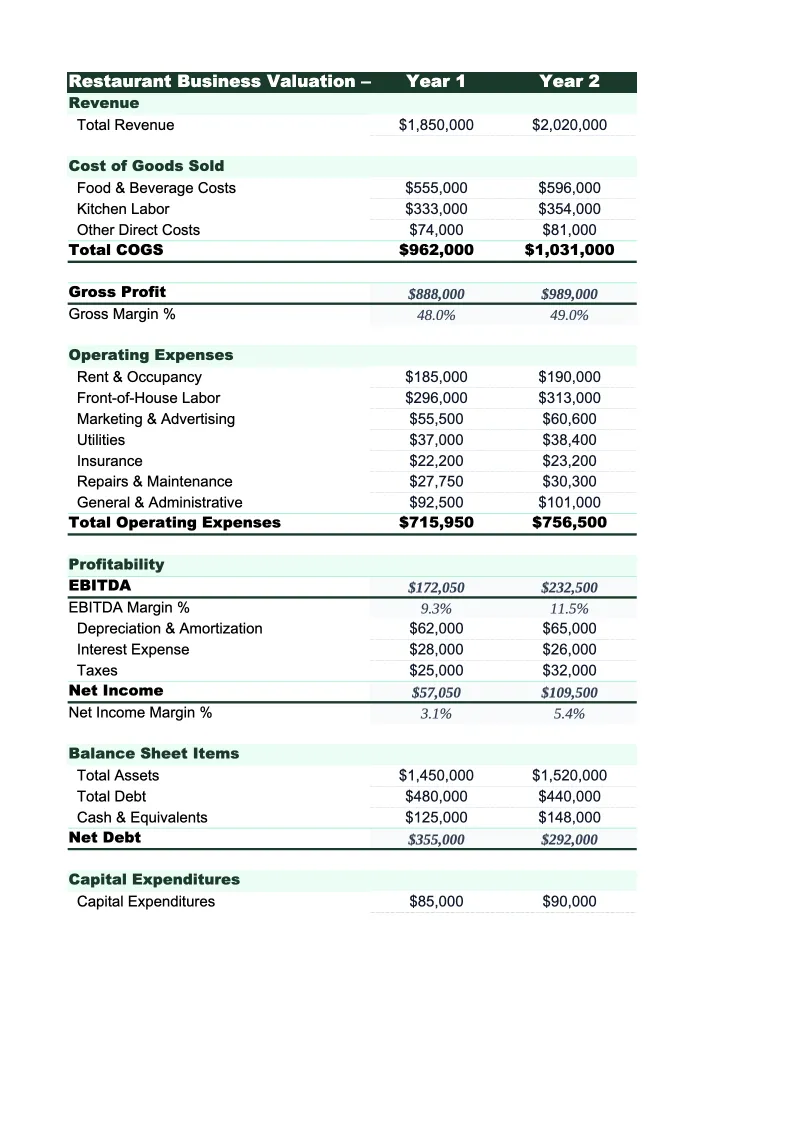
Start with the Inputs & Assumptions sheet. You'll need three things: your last two to three years of profit and loss statements, a current equipment list with rough fair market values, and your lease terms — expiration date, monthly rent, and whether it's transferable. Pull your P&L from your accountant or POS system and enter the top-line numbers. Don't use your tax return EBITDA directly; most restaurant owners run personal expenses through the business, and buyers will add those back anyway. The sheet walks you through each normalization item so nothing gets missed.
Once your inputs are set, work through each method sheet. The Income Approach is where most of the action is — review the SDE you calculated, confirm the normalization items look right, then select the SDE multiple range that fits your restaurant. Location quality, lease length, concept transferability, and whether the business can run without you are the main factors. The Market Approach gives you a revenue multiple cross-check. The Asset Approach matters more for restaurants than most people expect — kitchen equipment depreciates slowly, and a well-maintained hood system and walk-in cooler have real liquidation value.
Know what your restaurant is worth before a buyer does
Download the template, enter your financials, and walk into any broker or buyer conversation with a number you can defend.
How Restaurants Are Valued When They Sell
Restaurants are among the most frequently bought and sold small businesses, but they're also among the hardest to value correctly. The core challenge is that most independent restaurants are deeply owner-dependent — the chef, the relationships with regulars, the supplier terms — and a buyer is essentially paying for future cash flows they'll generate after the current owner leaves. That's why Seller's Discretionary Earnings, not revenue, drives most restaurant valuations. SDE captures what the business actually puts in an owner-operator's pocket each year and normalizes out the personal expenses and below-market owner salaries that make P&Ls misleading.
Independent restaurants typically sell for 1.5x–3x SDE. The low end of that range is a struggling concept with a short lease or high owner-dependence. The high end is a profitable, well-documented business in a strong location with a long, transferable lease and a management team that doesn't rely on the owner to function. Revenue multiples (0.3x–0.7x of annual revenue) are used as a secondary check — a restaurant valued at 4x revenue is probably priced on ego, not earnings, and buyers know it. Bars with liquor licenses in scarce markets can trade above these ranges because the license itself has real scarcity value.
Restaurant Industry at a Glance
Financial templates built for restaurants — from fast-casual to fine dining. Pre-loaded with food cost categories, labor splits, and industry-standard KPIs.
Revenue Drivers
- Dine-in sales
- Takeout & delivery
- Catering
- Alcohol sales
Key Cost Categories
- Food costs (COGS)
- Labor
- Rent & occupancy
- Utilities
- Marketing
- Equipment & maintenance
Typical Margins
Gross: 60-70% · Net: 3-9%
Seasonality
Higher revenue in summer and holiday seasons; January-February typically slowest months.
Key Performance Indicators
Restaurant Business Valuation FAQ
More Restaurant Templates
Restaurant Balance Sheet Template for Excel
$29
Restaurant Budget Template for Excel
$29
Restaurant Business Plan Template for Excel
$39
Restaurant Cash Flow Template for Excel
$29
Restaurant Expense Tracker Template for Excel
$29
Restaurant Financial Model Template for Excel
$29
Restaurant Income Statement Template for Excel
$29
Restaurant Invoice Template for Excel
$29
Restaurant KPI Dashboard Template for Excel
$29
Restaurant P&L Template for Excel
$29
Restaurant Pro Forma Template for Excel
$29
Restaurant Project Budget Template for Excel
$29
Restaurant Sales Forecast Template for Excel
$29
Restaurant Valuation Template
$29