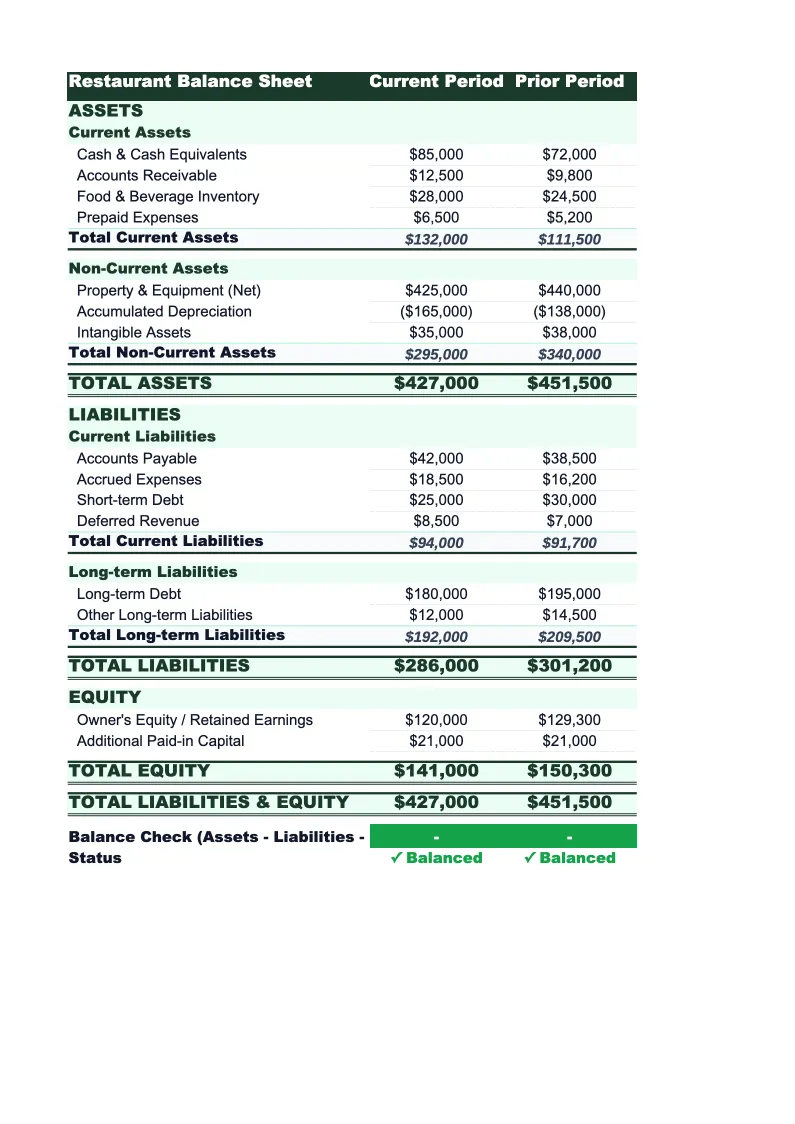
Restaurant Balance Sheet Template
See exactly what your restaurant owns, owes, and is worth — a balance sheet built for food service with food and beverage inventory, gift card liabilities, leasehold improvements, and kitchen equipment schedules.
What's Inside This Restaurant Balance Sheet Template
This template includes 4 worksheets, each designed for a specific part of your restaurant financial workflow:
Balance Sheet
The core financial statement organized around the restaurant chart of accounts.
Inventory Tracker
A period-end inventory count sheet that feeds food and beverage values into the balance sheet.
Fixed Assets
A fixed-asset register tracking every major piece of kitchen equipment, furniture, technology, and leasehold improvement the restaurant owns or has invested in.
Period Comparison
A side-by-side view of two balance sheet dates — typically the current period-end against the prior year-end, or the same quarter from one year to the next.
Restaurant Balance Sheet Template Features
- Food and beverage inventory split into separate categories with cost-per-unit calculations
- Gift card liability tracked as its own current liability line item
- Fixed asset register with depreciation schedules for kitchen equipment and leasehold improvements
- Accounts payable separated by vendor type — food suppliers, beverage distributors, and general vendors
- Accounting equation check — automatically flags any imbalance between assets and liabilities plus equity
- Period-over-period comparison for lender reporting, SBA renewals, and investor presentations
How to Use This Restaurant Balance Sheet Spreadsheet
Start with the Fixed Assets sheet before entering anything else. Pull your depreciation schedule from last year's tax return or your accountant's records and list every major asset: kitchen equipment, furniture and fixtures, POS system, leasehold improvements. Enter the original cost, purchase date, and useful life, and the sheet handles depreciation calculations and produces category totals that flow into the balance sheet automatically. Leasehold improvements are often the largest line item for a restaurant — make sure you record the full build-out cost and remaining amortization period, not just what's left on the loan.
Next, complete the Inventory Tracker with a physical count of your food and beverage stock at the end of the period. Pull current purchase costs from your most recent invoices and enter them alongside the unit counts. The sheet calculates ending inventory value by category and feeds the totals into the balance sheet's current assets section. Then fill in the rest of the balance sheet: pull cash from your bank statement, accounts receivable from any outstanding catering or delivery platform balances, accounts payable from your vendor aging report, and gift card liability from your POS system's gift card ledger.
15 minutes from download to your first restaurant balance sheet
Download the template, enter your accounts and inventory, and see your restaurant's full financial position — assets, liabilities, gift card obligations, and owner's equity included.
Why Every Restaurant Needs a Balance Sheet Template
Most restaurant owners track revenue and costs closely but rarely look at their balance sheet. The P&L tells you whether you made money last month; the balance sheet tells you what the business is actually worth and whether it can survive a slow quarter. Restaurants operate on thin margins — typically 3–9% net — which means the business's financial resilience depends heavily on its balance sheet position: how much cash is on hand, how much is owed to vendors, whether the equipment is fully depreciated and due for replacement, and whether any surprise liability (like a pile of unredeemed gift cards) is sitting on the books.
Three items on a restaurant balance sheet are frequently overlooked or handled incorrectly. The first is inventory: food and beverage stock is a real current asset, and restaurants that estimate inventory rather than count it end up with understated COGS and overstated profits. The second is gift card liability: when a customer buys a $50 gift card, you've collected cash for a service not yet performed — that's a liability on your balance sheet until the card is redeemed. Restaurants that issue significant gift card volume can carry thousands of dollars in unredeemed balances that belong on the liability side. The third is leasehold improvements: the build-out costs for a restaurant location — kitchen construction, HVAC, flooring, lighting — are capitalized assets amortized over the lease term. Missing these from the balance sheet understates both assets and the true capital invested in the business.
Restaurant Industry at a Glance
Financial templates built for restaurants — from fast-casual to fine dining. Pre-loaded with food cost categories, labor splits, and industry-standard KPIs.
Revenue Drivers
- Dine-in sales
- Takeout & delivery
- Catering
- Alcohol sales
Key Cost Categories
- Food costs (COGS)
- Labor
- Rent & occupancy
- Utilities
- Marketing
- Equipment & maintenance
Typical Margins
Gross: 60-70% · Net: 3-9%
Seasonality
Higher revenue in summer and holiday seasons; January-February typically slowest months.
Key Performance Indicators
Restaurant Balance Sheet Template FAQ
More Restaurant Templates
Restaurant Budget Template for Excel
$29
Restaurant Business Plan Template for Excel
$39
Restaurant Cash Flow Template for Excel
$29
Restaurant Expense Tracker Template for Excel
$29
Restaurant Financial Model Template for Excel
$29
Restaurant Income Statement Template for Excel
$29
Restaurant Invoice Template for Excel
$29
Restaurant KPI Dashboard Template for Excel
$29
Restaurant P&L Template for Excel
$29
Restaurant Pro Forma Template for Excel
$29
Restaurant Project Budget Template for Excel
$29
Restaurant Sales Forecast Template for Excel
$29
Restaurant Valuation Template for Excel
$29
More Balance Sheet Templates
Restaurant Balance Sheet Template
$29