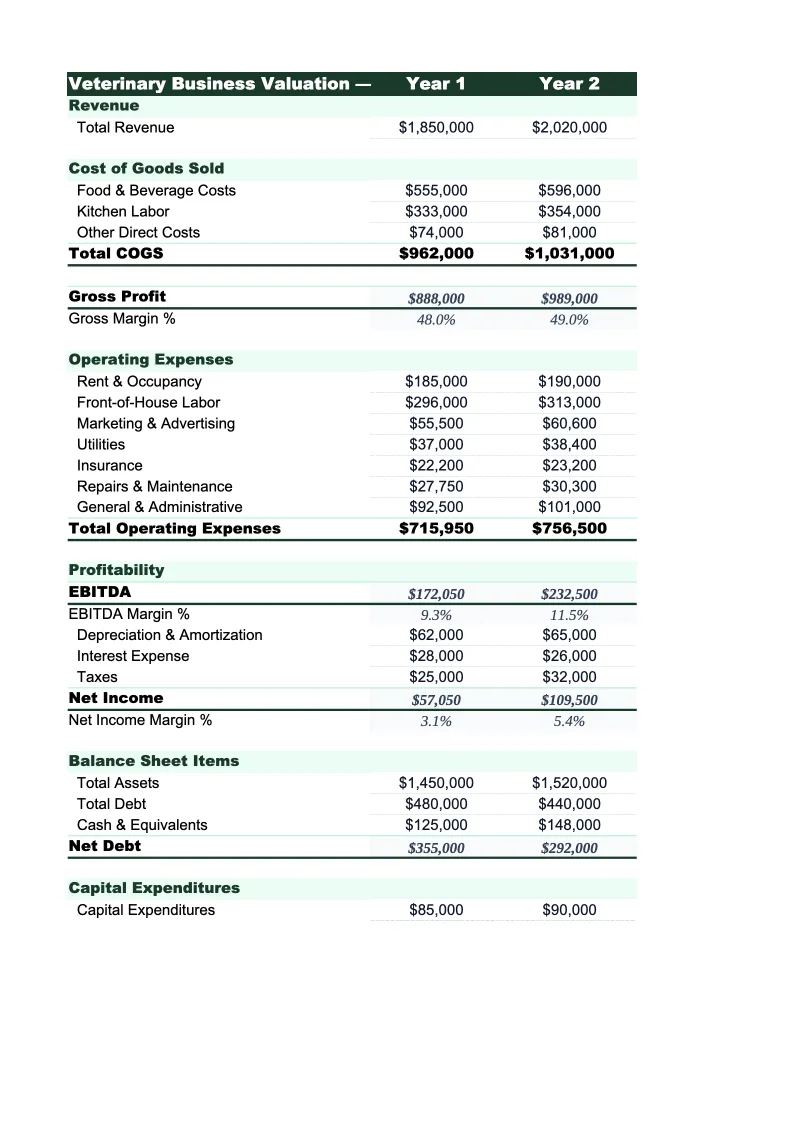
Veterinary Valuation Template
Value your veterinary practice using revenue multiples, a normalized EBITDA approach, and a value drivers scorecard — with benchmarks built around how veterinary practices actually sell to private buyers and corporate consolidators.
What's Inside This Veterinary Practice Valuation Template
This template includes 6 worksheets, each designed for a specific part of your veterinary financial workflow:
Practice Inputs
The data foundation for the entire model.
Revenue Multiple Approach
The primary screening method that consolidators and brokers use first when evaluating veterinary practices.
EBITDA Multiple Approach
The income-based valuation that SBA lenders, private equity-backed consolidators, and sophisticated individual buyers use for underwriting.
Asset Inventory
Calculates the tangible asset component of the practice value, which serves as the floor for any transaction and is required input for any SBA-financed acquisition.
Value Drivers Scorecard
A structured scoring model for the factors that most directly affect where a veterinary practice falls within its valuation range.
Valuation Summary
A single-page output consolidating all three valuation approaches into one view across conservative, base, and optimistic scenarios.
Veterinary Practice Valuation Template Features
- Revenue multiple calculation with per-active-client implied value benchmarked to veterinary practice transactions
- EBITDA normalization with DVM associate wage replacement and veterinary-specific add-back categories for owner compensation
- Tangible asset inventory covering diagnostic imaging, laboratory equipment, surgical suite, and goodwill components
- Value drivers scorecard scoring revenue per DVM, ACT, active client retention, service mix, and DVM dependency
- Consolidator acquisition pricing comparison alongside private-buyer multiples in the Valuation Summary
- Three-scenario output with EBITDA sensitivity table and revenue multiple range showing full negotiation band
How to Use This Veterinary Practice Valuation Spreadsheet
Start with the Practice Inputs sheet. Pull your trailing twelve-month revenue by service category from your practice management software — most systems (Avimark, Cornerstone, eVetPractice) have production and revenue summary reports that break this out by service type. You'll need the full expense structure from your P&L, owner compensation including any draws or personal expenses through the practice, and operational data: active client count (seen within 24 months), average client transaction for the last 12 months, number of DVMs as full-time equivalents, exam room count, and whether you offer emergency or specialty services. If your books don't clearly separate pharmaceutical COGS from general supplies, pull those from your inventory reports — medications and supplies together typically run 20–28% of revenue in a general practice, and buyers scrutinize this number closely as a proxy for operational efficiency.
Work through the Revenue Multiple and EBITDA Multiple sheets together, then score the Value Drivers Scorecard. The EBITDA normalization requires you to honestly account for all owner compensation — not just the base salary but any additional draws, production bonuses, profit distributions, vehicle, CE, and personal expenses that run as business costs. The associate replacement wage defaults to $120,000 in the model, which is a reasonable midpoint for a full-time associate DVM in general practice; adjust this to reflect your regional market, since veterinarian compensation varies meaningfully by geography and specialty. The Value Drivers Scorecard is where practices earn or lose their premium within the range: revenue per DVM FTE and DVM dependency are the two metrics consolidators focus on first, and the scorecard shows exactly how each factor moves your multiple.
Know what your veterinary practice is worth before you sell
Enter your revenue, EBITDA, active client data, and operational metrics — and get a defensible valuation range with the revenue multiple, EBITDA approach, and value drivers scorecard that private buyers and consolidators will use to make their offer.
How Veterinary Practices Are Valued When They Sell
Veterinary practice valuations have changed significantly since the consolidation wave began in earnest around 2015. The entry of large corporate buyers — Mars Veterinary Health, National Veterinary Associates, Pathway Vet Alliance, and dozens of private equity-backed regional groups — has pushed multiples well above historical norms for qualifying practices, while solo general practices selling to individual buyers still trade in a much narrower range. Most general veterinary practices have historically sold at 0.8–1.0x annual revenue or 4.0–6.0x normalized EBITDA in private-buyer transactions; consolidator acquisitions for practices that fit their growth strategy have reached 1.0–1.5x revenue or 7.0–12.0x EBITDA. The gap between private and corporate pricing is the first thing a selling veterinarian needs to understand, because the right path depends entirely on your practice profile.
The most important operational factors in a veterinary valuation are revenue per DVM, average client transaction, and DVM dependency. Revenue per DVM FTE measures how efficiently your doctors generate production — high-production practices exceeding $800,000 per DVM are demonstrably more valuable than those running at $450,000–$500,000 per DVM with the same headcount, because buyers are acquiring earning capacity per doctor slot, not just current revenue. Average client transaction, or ACT, is a proxy for the practice's clinical thoroughness and client compliance: a practice with ACT above $350 is capturing diagnostics, dentistry, and multi-item wellness visits that a practice with ACT of $200 is leaving on the table, and that difference compounds into materially different EBITDA margins. DVM dependency is the risk factor: if 70% of active clients are loyal specifically to the selling DVM rather than the practice, staff, and location, buyers price a transition risk premium that depresses the multiple.
Veterinary Industry at a Glance
Financial templates built for veterinary practices — from small animal clinics to multi-location hospitals. Pre-loaded with exam, surgery, pharmacy, and diagnostic categories.
Revenue Drivers
- Wellness exams and preventive care
- Surgical procedures
- Pharmacy and medication sales
- Diagnostics and lab work
- Dental procedures
- Emergency and urgent care
Key Cost Categories
- Medications and pharmaceuticals (COGS)
- Medical and surgical supplies
- Veterinarian salaries
- Technician and support staff wages
- Facility rent and utilities
- Diagnostic equipment and lab fees
Typical Margins
Gross: 74-78% · Net: 10-15%
Seasonality
Spring and fall peaks for wellness visits and heartworm testing; summer uptick in emergency visits; relatively stable year-round compared to many industries.
Key Performance Indicators
Veterinary Practice Valuation FAQ
More Veterinary Templates
Veterinary Practice Balance Sheet Template for Excel
$29
Veterinary Budget Template for Excel
$29
Veterinary Business Plan Template for Excel
$39
Veterinary Practice Cash Flow Template for Excel
$29
Veterinary Expense Tracker Template for Excel
$29
Veterinary Practice Financial Model Template for Excel
$29
Veterinary Income Statement Template for Excel
$29
Veterinary Invoice Template for Excel
$29
Veterinary Practice KPI Dashboard Template for Excel
$29
Veterinary Practice P&L Template for Excel
$29
Veterinary Pro Forma Template for Excel
$29
Veterinary Project Budget Template for Excel
$29
Veterinary Sales Forecast Template for Excel
$29
Veterinary Valuation Template
$29