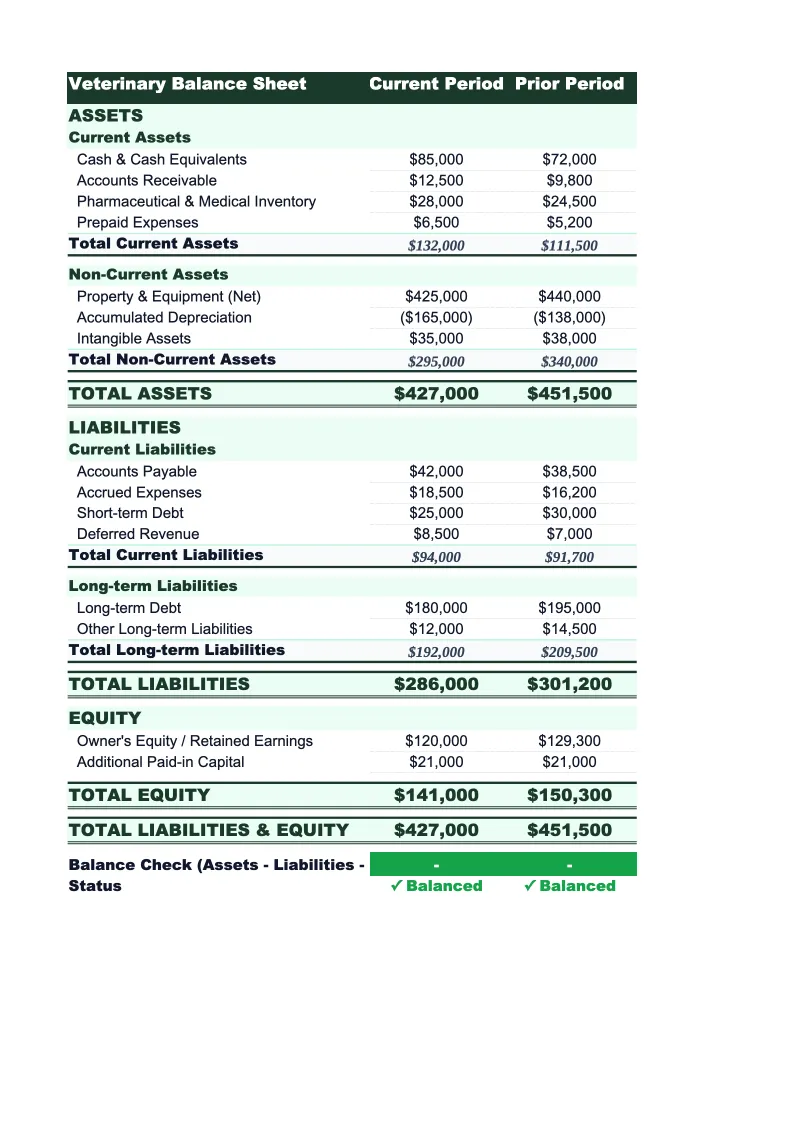
Veterinary Balance Sheet Template
See exactly what your veterinary practice owns, owes, and is worth — a balance sheet built for vet clinics with pharmaceutical inventory tracking, diagnostic equipment depreciation, and wellness plan deferred revenue.
What's Inside This Veterinary Practice Balance Sheet Template
This template includes 4 worksheets, each designed for a specific part of your veterinary financial workflow:
Balance Sheet
The core financial statement organized around the veterinary practice chart of accounts.
Inventory Tracker
A pharmaceutical and supply inventory worksheet that tracks the value of the practice's product holdings — the asset that most distinguishes a veterinary balance sheet from a pure service business.
Fixed Assets
A fixed-asset register tracking every major piece of veterinary equipment, diagnostic technology, and leasehold improvement the practice owns.
Period Comparison
A side-by-side view of two balance sheet dates — typically the current period-end against the prior year-end — showing dollar and percentage change for every line item across assets, liabilities, and equity.
Veterinary Practice Balance Sheet Template Features
- Pharmaceutical and vaccine inventory tracker with controlled substance line item — values the product asset that most distinguishes a vet balance sheet
- Deferred revenue tracking for prepaid wellness and preventive care plans — a current liability many practices miss
- Fixed asset register with depreciation schedules for diagnostic equipment, anesthesia machines, laboratory analyzers, and practice vehicles
- Accounts payable split by distributor (Covetrus, Henry Schein, MWI) and diagnostic lab (IDEXX, Antech) for clean vendor tracking
- Accounting equation check — automatically flags any imbalance between total assets and liabilities plus equity
- Period-over-period comparison for lender reporting, acquisition due diligence, and partner buy-in conversations
How to Use This Veterinary Practice Balance Sheet Spreadsheet
Start with the Fixed Assets sheet before entering anything else. Pull your depreciation schedule from last year's tax return or your accountant's workpapers and enter every major asset: anesthesia and monitoring equipment, digital radiography and dental X-ray systems, ultrasound units, in-house laboratory analyzers (IDEXX, Antech, or equivalent), endoscopy equipment, surgical tables, computers, practice vehicles, and leasehold improvements to exam rooms and surgery suites. Enter the original cost, purchase date, and useful life for each item — the sheet calculates depreciation automatically and produces category totals that populate the non-current assets section of the balance sheet. Veterinary practices can carry $100,000–$400,000 or more in diagnostic and treatment equipment, and getting these properly depreciated is foundational to an accurate picture of practice net worth.
Next, complete the Inventory Tracker. Do a physical count of pharmaceutical inventory — prescription medications, vaccines and biologicals, parasiticides and preventives, retail OTC products — and enter unit costs and quantities. Most practice management systems can export a product inventory report as a starting point. Track controlled substances separately, both because DEA compliance requires accurate records and because they represent a separate line of internal accountability. Then fill in the rest of the balance sheet: operating cash from your bank statement, client accounts receivable from your practice management system (most small animal practices collect at time of service, but large animal and mixed practices with farm accounts may carry meaningful AR), deferred revenue from any prepaid wellness plans from your plan enrollment records, accounts payable from your distributor statements, and accrued lab fees from your outstanding reference lab invoices.
15 minutes from download to your first practice balance sheet
Download the template, enter your inventory and equipment schedule, and see your veterinary practice's full financial position — assets, liabilities, deferred revenue, and owner's equity included.
Why Every Veterinary Practice Needs a Balance Sheet Template
Veterinary practices operate as a hybrid between a service business and a product business. Unlike law firms, consulting practices, or most healthcare providers, a significant portion of a vet clinic's revenue comes from products — pharmaceuticals dispensed and sold in the clinic, vaccines administered, parasiticide preventives sold at checkout, and prescription diets. That means a veterinary balance sheet carries a current asset — pharmaceutical inventory — that most pure service businesses do not have. A clinic with active product sales might hold $25,000–$80,000 worth of pharmaceutical and supply inventory at any point in time. Leaving that off the balance sheet, or carrying it at a rough estimate, understates practice assets and distorts the net worth calculation that lenders, buyers, and partners rely on.
Two other balance sheet items that veterinary practices commonly mishandle are deferred revenue from wellness plans and accounts payable to diagnostic reference labs. Wellness and preventive care plans — annual packages covering exams, vaccines, heartworm testing, and preventives for a flat monthly fee — are increasingly common across both independent clinics and corporate groups. When a client pays upfront or is billed monthly in advance, the unearned portion is a current liability, not income. A practice with 300 active wellness plan clients paying $50/month is carrying several thousand dollars in deferred revenue at any billing cycle — real obligations that belong on the balance sheet. Similarly, most practices run reference lab work through IDEXX, Antech, or VCA and receive bills on 30-day terms; those outstanding invoices are current liabilities that should appear as accrued diagnostic lab fees rather than being absorbed into a catch-all 'accounts payable' line.
Veterinary Industry at a Glance
Financial templates built for veterinary practices — from small animal clinics to multi-location hospitals. Pre-loaded with exam, surgery, pharmacy, and diagnostic categories.
Revenue Drivers
- Wellness exams and preventive care
- Surgical procedures
- Pharmacy and medication sales
- Diagnostics and lab work
- Dental procedures
- Emergency and urgent care
Key Cost Categories
- Medications and pharmaceuticals (COGS)
- Medical and surgical supplies
- Veterinarian salaries
- Technician and support staff wages
- Facility rent and utilities
- Diagnostic equipment and lab fees
Typical Margins
Gross: 74-78% · Net: 10-15%
Seasonality
Spring and fall peaks for wellness visits and heartworm testing; summer uptick in emergency visits; relatively stable year-round compared to many industries.
Key Performance Indicators
Veterinary Practice Balance Sheet Template FAQ
More Veterinary Templates
Veterinary Budget Template for Excel
$29
Veterinary Business Plan Template for Excel
$39
Veterinary Practice Cash Flow Template for Excel
$29
Veterinary Expense Tracker Template for Excel
$29
Veterinary Practice Financial Model Template for Excel
$29
Veterinary Income Statement Template for Excel
$29
Veterinary Invoice Template for Excel
$29
Veterinary Practice KPI Dashboard Template for Excel
$29
Veterinary Practice P&L Template for Excel
$29
Veterinary Pro Forma Template for Excel
$29
Veterinary Project Budget Template for Excel
$29
Veterinary Sales Forecast Template for Excel
$29
Veterinary Practice Valuation Template for Excel
$29
More Balance Sheet Templates
Veterinary Balance Sheet Template
$29