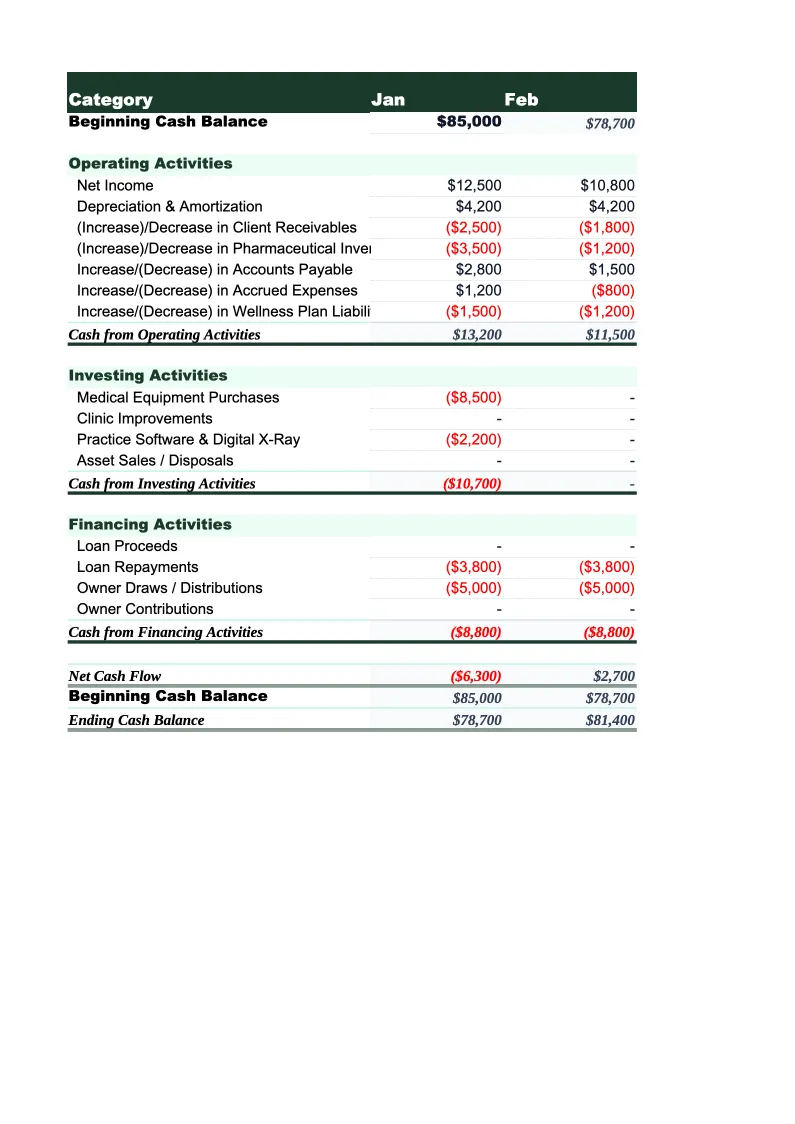
Veterinary Cash Flow Template
Track and project cash flow for your veterinary practice — with pharmacy COGS timing, DVM and technician payroll, diagnostic lab invoices, pet insurance reimbursements, and a 13-week projection built around the cash gaps clinic owners actually face.
What's Inside This Veterinary Cash Flow Template
This template includes 4 worksheets, each designed for a specific part of your veterinary financial workflow:
13-Week Cash Flow
A rolling 13-week cash projection covering the most actionable planning window for a veterinary practice.
Monthly Cash Flow
A 12-month indirect-method cash flow statement organized into operating, investing, and financing activities.
Pharmacy & COGS Tracker
A dedicated sheet for tracking pharmaceutical purchases, inventory turns, and cost of goods sold — the largest variable cost in most veterinary practices, accounting for 20–30% of revenue across medications, vaccines, and medical supplies.
Annual Summary
A full-year rollup of revenue, COGS, operating cash flow, and the KPIs that practice owners, DSO acquirers, and lenders use to evaluate a veterinary business.
Veterinary Cash Flow Template Features
- 13-week cash projection with over-the-counter collections, pet insurance reimbursements, and CareCredit/ScratchPay remittances tracked as separate inflows — each arriving on a different schedule
- Pharmacy & COGS Tracker covering pharmaceutical purchases by distributor, inventory turn calculations, COGS-to-revenue ratio, and upcoming invoice due dates fed into the weekly projection
- Bi-weekly payroll rows for veterinarians, licensed technicians, assistants, and front-desk staff — aligned to actual pay dates, not monthly averages
- External diagnostic lab invoice tracking (IDEXX, Antech) as a distinct outflow category separate from in-house supply orders, on net-30 billing cycles
- Inventory adjustment in the indirect monthly cash flow — so the model reflects the cash deployed to stock medications before they generate revenue
- COGS percentage, payroll-to-revenue ratio, average client transaction, and revenue per DVM hour — the four metrics lenders and acquirers look at first when evaluating a veterinary practice
How to Use This Veterinary Practice Cash Flow Spreadsheet
Download the .xlsx file and open it in Excel or Google Sheets. Start with the Pharmacy & COGS Tracker — enter last month's pharmaceutical purchases by distributor, your current inventory value, and the COGS consumed in the period. The sheet will calculate your COGS-to-revenue ratio immediately and show you your upcoming distributor invoice due dates. This is the starting input that makes the 13-week projection accurate, because pharmaceutical purchases represent the largest scheduled outflow for most practices and they arrive on net-30 terms that may fall in a different week than your revenue. Enter your current distributor payment due dates into the expense rows of the 13-Week Cash Flow sheet as your first step — these are non-negotiable outflows and should anchor the projection before you add revenue estimates.
Move to the 13-Week Cash Flow sheet and fill in projected revenue inflows week by week. Over-the-counter collections are the most predictable — use your average daily revenue and appointment schedule to estimate week-by-week inflows, adjusting for any known slow periods or scheduled high-volume weeks. Pet insurance reimbursements take 7–21 days after claim submission depending on the insurer; for most general practices these represent 5–15% of revenue but that share is growing. CareCredit and ScratchPay remittances typically arrive within 2–3 business days of the transaction, so they behave more like cash sales than insurance claims. Enter bi-weekly payroll amounts on the specific calendar dates they fall — for DVM associates especially, payroll is the most significant fixed outflow and the weeks it lands during lower-revenue periods are where cash shortfalls occur. Add external lab invoice due dates and any equipment financing payments.
15 minutes from download to your first cash flow projection
Download the template, enter your distributor invoice schedule and payroll dates, and see your veterinary practice's full cash picture — 13-week projection, pharmacy COGS tracker, and monthly statement included.
Why Veterinary Practices Need a Dedicated Cash Flow Template
Veterinary practices are fundamentally product-and-service businesses, and that dual nature creates cash flow complexity that generic financial templates don't handle well. On the service side — exams, surgeries, and procedures — revenue arrives almost entirely at the time of service, which is simpler than medical or dental billing. But on the product side — pharmaceuticals, preventives, therapeutic diets, and medical supplies — the practice must purchase inventory, store it, and then sell it, which creates a cash deployment gap between when money goes out to distributors and when it comes back in from clients. A practice that generates $200,000 in monthly revenue and carries a 25% COGS ratio has roughly $40,000–$50,000 per month cycling through pharmaceutical purchases, plus the inventory buffer it needs to maintain to avoid stockouts on critical items. Managing both the service revenue cycle and the product COGS cycle simultaneously is what makes veterinary cash flow distinctly harder to project than a pure-service business.
The metrics that matter most in veterinary practice cash flow are COGS as a percentage of revenue, staff payroll as a percentage of revenue, and average client transaction. COGS should stay in the 22–28% range for most general practices; rising ratios indicate shrinkage, waste, pricing problems on dispensed medications, or a product mix shift toward lower-margin items. Staff payroll at 40–50% of revenue is the target; the combined COGS and payroll percentage is the most important number in the practice because the two together represent 65–78% of revenue and there is very limited room for operating expenses before profitability disappears. Average client transaction — total collections divided by total patient visits — is the output metric that synthesizes everything: a practice with strong case acceptance, appropriate pharmacy pricing, and efficient appointment utilization will consistently generate $250–$350 per visit; one with compliance problems or underpriced services will run $150–$175 and find it nearly impossible to cover DVM compensation and overhead. External diagnostic lab fees deserve separate tracking because they arrive as invoices 30 days after the test is run — easy to lose track of against total COGS unless they're broken out.
Veterinary Industry at a Glance
Financial templates built for veterinary practices — from small animal clinics to multi-location hospitals. Pre-loaded with exam, surgery, pharmacy, and diagnostic categories.
Revenue Drivers
- Wellness exams and preventive care
- Surgical procedures
- Pharmacy and medication sales
- Diagnostics and lab work
- Dental procedures
- Emergency and urgent care
Key Cost Categories
- Medications and pharmaceuticals (COGS)
- Medical and surgical supplies
- Veterinarian salaries
- Technician and support staff wages
- Facility rent and utilities
- Diagnostic equipment and lab fees
Typical Margins
Gross: 74-78% · Net: 10-15%
Seasonality
Spring and fall peaks for wellness visits and heartworm testing; summer uptick in emergency visits; relatively stable year-round compared to many industries.
Key Performance Indicators
Veterinary Practice Cash Flow Template FAQ
More Veterinary Templates
Veterinary Practice Balance Sheet Template for Excel
$29
Veterinary Budget Template for Excel
$29
Veterinary Business Plan Template for Excel
$39
Veterinary Expense Tracker Template for Excel
$29
Veterinary Practice Financial Model Template for Excel
$29
Veterinary Income Statement Template for Excel
$29
Veterinary Invoice Template for Excel
$29
Veterinary Practice KPI Dashboard Template for Excel
$29
Veterinary Practice P&L Template for Excel
$29
Veterinary Pro Forma Template for Excel
$29
Veterinary Project Budget Template for Excel
$29
Veterinary Sales Forecast Template for Excel
$29
Veterinary Practice Valuation Template for Excel
$29
Veterinary Cash Flow Template
$29