Veterinary Pro Forma Template
Project revenue, expenses, and returns for a new veterinary practice, acquisition, or clinic expansion — with pre-built formulas for wellness visits, surgery, pharmacy, and diagnostics.
What's Inside This Veterinary Pro Forma Template
This template includes 7 worksheets, each designed for a specific part of your veterinary financial workflow:
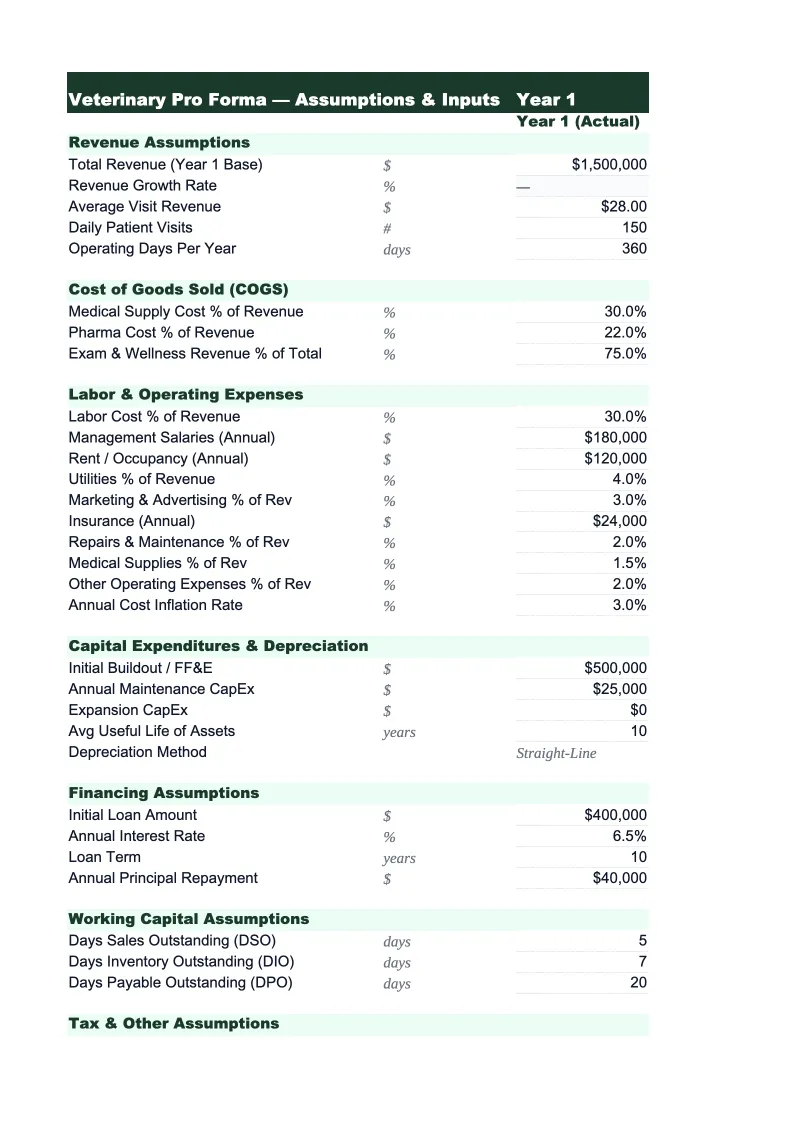
Assumptions
The control panel for your entire pro forma.
Revenue Projections
A 5-year monthly and annual revenue forecast broken out by service category: wellness exams and preventive care, surgical procedures, pharmacy and medication sales, diagnostics and laboratory work, dental procedures, and emergency and urgent care.
Expense Projections
A detailed 5-year expense forecast organized into three tiers: cost of goods sold (medications, vaccines, surgical supplies, lab reagents), labor costs (veterinarian salaries, technician wages, support staff, benefits and payroll taxes), and operating overhead (rent, utilities, equipment maintenance, malpractice insurance, marketing, software and technology, and administrative costs).
Capital Requirements
Itemizes the upfront investment needed to open or acquire a veterinary practice.
P&L Projection
A full projected income statement covering 5 years annually and year 1 monthly.
Cash Flow Projection
Projects monthly cash flow for year 1 and annual cash flow for years 2–5.
Dashboard
A one-page summary designed for lenders, investors, or partners.
Veterinary Pro Forma Template Features
- Service-level revenue modeling: wellness, surgery, pharmacy, diagnostics, dental, and emergency
- DVM productivity inputs: visits per day, revenue per DVM hour, and fee schedule assumptions
- Capital requirements calculator for new builds, buildouts, or acquisitions
- Monthly cash flow with loan amortization and break-even month calculation
- 5-year P&L with gross margin and EBITDA tracked against industry benchmarks
- Investor-ready dashboard with charts and return metrics — print-ready
How to Use This Veterinary Practice Pro Forma
Start with the Assumptions sheet — this is where the entire model is built. Enter your planned DVM headcount, exam rooms, target daily visit volume, and average transaction values for each service category. If you're projecting an existing practice, use last year's financials as your baseline; if you're starting from scratch, use industry benchmarks from AVMA or VetPartners data as your starting point. Most users spend 20–30 minutes in this sheet getting inputs right, and the rest of the model fills itself in.
Once your assumptions are in, review the Revenue Projections and Expense Projections sheets to make sure the outputs look realistic. Pay particular attention to COGS as a percentage of revenue — for a veterinary practice it should run 22–26% — and total labor as a percentage of revenue, which typically runs 40–50% when you include all staff and benefits. If either number looks off, adjust the corresponding Assumptions inputs rather than editing the projection sheets directly.
Your 5-year veterinary practice projection in under an hour
Download the template, enter your assumptions, and walk into your bank meeting with a credible, detailed financial projection for your veterinary practice.
Why Veterinary Practices Need a Pro Forma Before They Open
Veterinary practice financing has specific requirements that generic pro forma templates don't address. SBA loans are the most common funding source for new practice startups and acquisitions, and SBA lenders expect to see revenue modeled by service category — they want to understand your surgical vs. wellness mix, your pharmacy margin assumptions, and your DVM productivity targets. A pro forma that lumps all revenue into one line won't satisfy underwriting. The same is true for acquisition financing: when you're buying a practice at 0.6–0.8x gross revenue, you need to show the lender how you'll maintain or grow the revenue base under new ownership.
The financial structure of a veterinary practice is different from most small businesses. Gross margins look high on paper — 74–78% is typical — but labor costs consume 40–50% of revenue, which compresses net margins to 10–15% for a well-run practice. Equipment-heavy specialties like surgery and radiology require significant upfront capital and ongoing maintenance costs. Pharmacy revenue has strong margins but depends on prescription volume from your exam and surgery services. Understanding these interdependencies — and modeling them properly — is what separates a credible pro forma from a spreadsheet that looks good but can't survive a lender's review.
Veterinary Industry at a Glance
Financial templates built for veterinary practices — from small animal clinics to multi-location hospitals. Pre-loaded with exam, surgery, pharmacy, and diagnostic categories.
Revenue Drivers
- Wellness exams and preventive care
- Surgical procedures
- Pharmacy and medication sales
- Diagnostics and lab work
- Dental procedures
- Emergency and urgent care
Key Cost Categories
- Medications and pharmaceuticals (COGS)
- Medical and surgical supplies
- Veterinarian salaries
- Technician and support staff wages
- Facility rent and utilities
- Diagnostic equipment and lab fees
Typical Margins
Gross: 74-78% · Net: 10-15%
Seasonality
Spring and fall peaks for wellness visits and heartworm testing; summer uptick in emergency visits; relatively stable year-round compared to many industries.
Key Performance Indicators
Veterinary Pro Forma Template FAQ
More Veterinary Templates
Veterinary Practice Balance Sheet Template for Excel
$29
Veterinary Budget Template for Excel
$29
Veterinary Business Plan Template for Excel
$39
Veterinary Practice Cash Flow Template for Excel
$29
Veterinary Expense Tracker Template for Excel
$29
Veterinary Practice Financial Model Template for Excel
$29
Veterinary Income Statement Template for Excel
$29
Veterinary Invoice Template for Excel
$29
Veterinary Practice KPI Dashboard Template for Excel
$29
Veterinary Practice P&L Template for Excel
$29
Veterinary Project Budget Template for Excel
$29
Veterinary Sales Forecast Template for Excel
$29
Veterinary Practice Valuation Template for Excel
$29
Veterinary Pro Forma Template
$29