Manufacturing Cash Flow Template
Track cash in and out across your production cycle with a cash flow template built for manufacturers — covering raw material procurement, AR/AP timing, CapEx, and working capital.
What's Inside This Manufacturing Cash Flow Template
This template includes 5 worksheets, each designed for a specific part of your manufacturing financial workflow:
Monthly Cash Flow
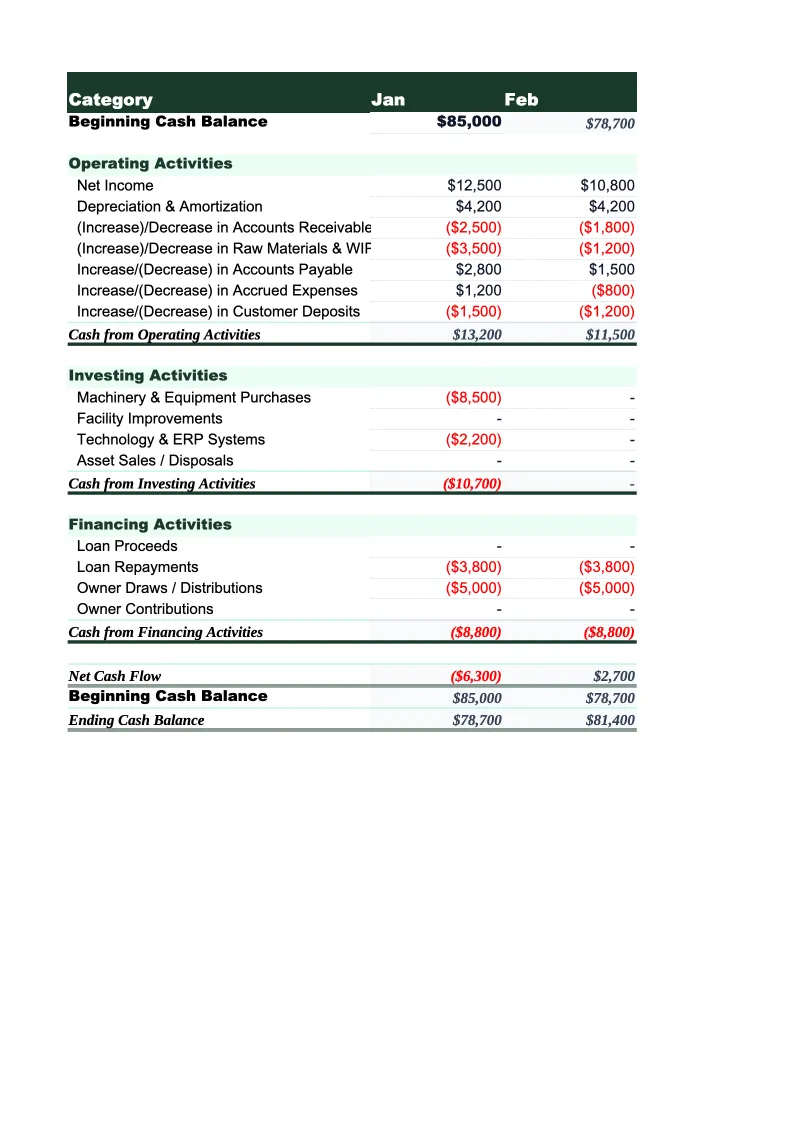
The core operating worksheet tracking cash inflows and outflows by month across three activities: operating (customer receipts, supplier payments, direct labor, overhead), investing (equipment purchases, facility improvements, tooling costs), and financing (loan repayments, line of credit draws, owner distributions).
Working Capital Tracker
A dedicated worksheet for monitoring the three working capital components that drive cash flow in manufacturing: accounts receivable (money customers owe you), accounts payable (money you owe suppliers), and inventory (raw materials, work-in-process, and finished goods).
Annual Cash Flow
A 12-month cash flow statement using the indirect method, starting from net income and adjusting for non-cash items (depreciation, amortization), changes in working capital (AR, inventory, AP), and capital expenditures.
CapEx & Equipment Tracker
A capital expenditure planning sheet where you list planned equipment purchases, tooling investments, and facility upgrades along with their cost, financing method (cash, loan, or lease), and timing.
Dashboard
A single-page summary showing current cash position, 3-month cash trend, DSO vs.
Manufacturing Cash Flow Template Features
- Monthly cash flow with manufacturing-specific line items (raw materials, outside processing, freight, direct labor)
- Working capital tracker with DSO, DPO, and inventory turns calculated automatically
- Annual indirect-method cash flow statement formatted for lender and investor review
- CapEx and equipment planning tracker with quarterly cash impact view
- Ending cash balance and 3-month runway calculated for each period
- Visual dashboard with cash position, working capital ratios, and trend charts
How to Use This Manufacturing Cash Flow Spreadsheet
Start with the Monthly Cash Flow sheet. Download the file and open it in Excel or Google Sheets — no macros or plugins required. Enter your current cash balance in the opening balance cell, then work through the pre-loaded categories: customer receipts (pull from your AR aging), raw material payments due this month (pull from your AP schedule), direct labor payroll, and fixed overhead like utilities and insurance. Most manufacturers can complete the first month in 20–30 minutes using bank statements and their accounts payable aging report.
Set up the Working Capital Tracker each month alongside the cash flow sheet. Enter your AR aging balances by bucket (current, 30, 60, 90+ days), your AP balances by due date, and your inventory value split between raw materials, work-in-process, and finished goods. The sheet calculates DSO, DPO, and inventory turns automatically. These three numbers tell you where cash is getting trapped — if your DSO is climbing while DPO stays flat, customers are paying slower while you're still paying suppliers on time, which is a working capital squeeze that will show up in your cash balance before long.
15 minutes from download to your first cash flow projection
Download the template, enter your AR aging and supplier payment schedule, and see your manufacturing company's 90-day cash position at a glance.
Why Manufacturers Need a Dedicated Cash Flow Template
Manufacturing businesses face a cash flow challenge that most service businesses don't: the production cycle creates a long gap between spending and receiving. You buy raw materials, pay direct labor, carry work-in-process through the production cycle, ship finished goods, invoice the customer, and then wait 30–60 days for payment. All of that time, cash is flowing out. A manufacturer running $5M in annual revenue with Net-45 customer terms and Net-30 supplier terms can have $400K–$700K of cash tied up in working capital at any given time — that's money the business needs to operate but that doesn't show up as a problem on a P&L.
The working capital ratios that matter most for manufacturers are Days Sales Outstanding (DSO), Days Payable Outstanding (DPO), and inventory turns. DSO tells you how fast customers pay — the industry average runs 35–50 days for most manufacturers, but companies selling to large retail chains or government contractors often see 60–90+ days. DPO tells you how long you're taking to pay suppliers — stretching payables is a common cash management tool but has limits depending on supplier relationships and terms. Inventory turns tell you how efficiently you're converting raw materials into shipped product — most manufacturers target 6–12 turns per year, with job shops often lower and high-volume producers higher. When DSO is high, DPO is low, and inventory turns are slow, you have a compounding working capital problem.
Manufacturing Industry at a Glance
Financial templates built for manufacturers — from job shops and contract fabricators to production facilities. Pre-loaded with cost categories, billing structures, and KPIs specific to how manufacturers track materials, labor, and overhead.
Revenue Drivers
- Product sales
- Contract/job shop work
- Tooling and setup fees
- NRE charges
- Material markups
- Aftermarket parts and service
Key Cost Categories
- Raw materials / direct materials
- Direct labor
- Manufacturing overhead
- Outside processing / subcontracting
- Equipment depreciation
- SG&A
Typical Margins
Gross: 20-35% · Net: 4-10%
Seasonality
Q1 weakest across most segments. Q3/Q4 strongest for consumer goods and construction materials manufacturers. Automotive suppliers follow OEM model-year shutdowns. Industrial equipment sees Q4 budget-spend surge.
Key Performance Indicators
Manufacturing Cash Flow Template FAQ
More Manufacturing Templates
Manufacturing Balance Sheet Template for Excel
$29
Manufacturing Budget Template for Excel
$29
Manufacturing Business Plan Template for Excel
$39
Manufacturing Expense Tracker Template for Excel
$29
Manufacturing Financial Model Template for Excel
$29
Manufacturing Income Statement Template for Excel
$29
Manufacturing Invoice Template for Excel
$29
Manufacturing KPI Dashboard Template for Excel
$29
Manufacturing P&L Template for Excel
$29
Manufacturing Pro Forma Template for Excel
$29
Manufacturing Project Budget Template for Excel
$29
Manufacturing Sales Forecast Template for Excel
$29
Manufacturing Business Valuation Template for Excel
$29
Manufacturing Cash Flow Template
$29