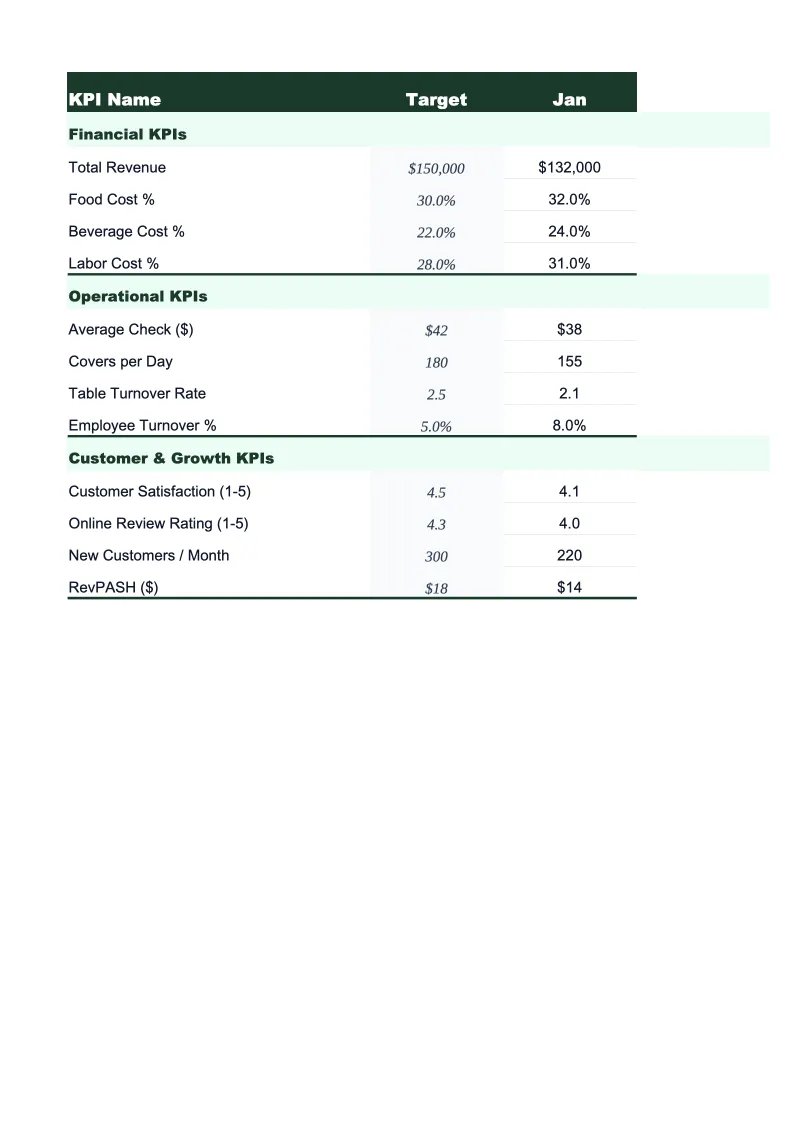
Manufacturing KPI Dashboard Template
Track every operational and financial metric that matters on the plant floor — OEE, scrap rate, on-time delivery, inventory turns, and cost per unit — in a single Excel dashboard built for manufacturers.
What's Inside This Manufacturing KPI Dashboard Template
This template includes 6 worksheets, each designed for a specific part of your manufacturing financial workflow:
KPI Dashboard
The main overview sheet with all key metrics visualized in one place.
Production Metrics
Where you enter and track the core operational data for your production floor.
Quality Metrics
Track product quality at the line level across three key dimensions: first-pass yield (units passing inspection on the first attempt), scrap rate (material lost to defects as a percentage of total input), and customer return rate (warranty claims and returns as a percentage of units shipped).
Inventory Metrics
Monitor inventory levels and turns across three categories: raw materials, work-in-progress (WIP), and finished goods.
Financial KPIs
Track the manufacturing financials that don't live in a standard P&L: cost per unit produced (broken down into direct material, direct labor, and overhead components), standard cost vs.
Monthly Targets
A single sheet where you set all your KPI targets for the year — one row per metric, one column per month.
Manufacturing KPI Dashboard Features
- OEE calculation (Availability × Performance × Quality) with breakdown by loss category
- First-pass yield, scrap rate, and defect rate tracking with trend charts
- Inventory turnover and days-on-hand for raw materials, WIP, and finished goods
- Cost per unit vs. standard cost variance across material, labor, and overhead
- Color-coded performance indicators that pull from a centralized targets sheet
- 12-month KPI trend charts for production, quality, inventory, and financial metrics
How to Use This Manufacturing KPI Spreadsheet
Start by setting your targets in the Monthly Targets sheet. Enter your OEE goal, first-pass yield target, inventory turnover target, cost per unit standard, and any other benchmarks you're managing to. You only need to do this once at the beginning of the year — or adjust mid-year if targets change. All the color-coded status indicators across the dashboard reference this sheet, so setting accurate targets is the most important first step.
Once targets are set, enter your operational data at whatever frequency matches how you run the floor. Most manufacturers update production and quality metrics weekly, inventory metrics monthly, and financial KPIs monthly after closing the books. The Production Metrics and Quality Metrics sheets have date-stamped rows so you can enter data as it comes in. The Financial KPIs sheet works best with month-end inputs from your cost accounting system — pull cost per unit, actual labor hours, and overhead allocation from your ERP or job costing reports.
15 minutes from download to your first manufacturing dashboard
Download the template, set your targets, and start your next production review with every KPI on one screen.
Why Every Manufacturer Needs a KPI Dashboard
Most manufacturing companies track dozens of metrics, but the ones that drive profitability are a much shorter list. OEE (Overall Equipment Effectiveness) is the single most important production metric for most facilities — it combines availability, performance, and quality into one number that reflects what percentage of planned production time is actually generating good product. The industry average hovers around 60–70%, while world-class manufacturers run at 85% or above. A 10-point OEE improvement typically adds 10–15% to output capacity without adding headcount or equipment — which is why it shows up on every serious manufacturing dashboard.
Beyond OEE, the metrics that matter most are the ones that connect operational performance to cost. Cost per unit vs. standard cost tells you whether your production processes are running as efficiently as planned — and when they're not, the breakdown into material, labor, and overhead components points you toward the cause. Scrap rate ties directly to material cost: a 3% scrap rate on a $50 raw material input means $1.50 per unit in hidden waste before a single operator adds value. Inventory turnover affects working capital — manufacturers that turn inventory 6–8 times per year carry half the working capital of those turning it 3–4 times, which matters when interest rates are high or cash is tight.
Manufacturing Industry at a Glance
Financial templates built for manufacturers — from job shops and contract fabricators to production facilities. Pre-loaded with cost categories, billing structures, and KPIs specific to how manufacturers track materials, labor, and overhead.
Revenue Drivers
- Product sales
- Contract/job shop work
- Tooling and setup fees
- NRE charges
- Material markups
- Aftermarket parts and service
Key Cost Categories
- Raw materials / direct materials
- Direct labor
- Manufacturing overhead
- Outside processing / subcontracting
- Equipment depreciation
- SG&A
Typical Margins
Gross: 20-35% · Net: 4-10%
Seasonality
Q1 weakest across most segments. Q3/Q4 strongest for consumer goods and construction materials manufacturers. Automotive suppliers follow OEM model-year shutdowns. Industrial equipment sees Q4 budget-spend surge.
Key Performance Indicators
Manufacturing KPI Dashboard FAQ
More Manufacturing Templates
Manufacturing Balance Sheet Template for Excel
$29
Manufacturing Budget Template for Excel
$29
Manufacturing Business Plan Template for Excel
$39
Manufacturing Cash Flow Template for Excel
$29
Manufacturing Expense Tracker Template for Excel
$29
Manufacturing Financial Model Template for Excel
$29
Manufacturing Income Statement Template for Excel
$29
Manufacturing Invoice Template for Excel
$29
Manufacturing P&L Template for Excel
$29
Manufacturing Pro Forma Template for Excel
$29
Manufacturing Project Budget Template for Excel
$29
Manufacturing Sales Forecast Template for Excel
$29
Manufacturing Business Valuation Template for Excel
$29
More KPI Dashboard Templates
Manufacturing KPI Dashboard Template
$29