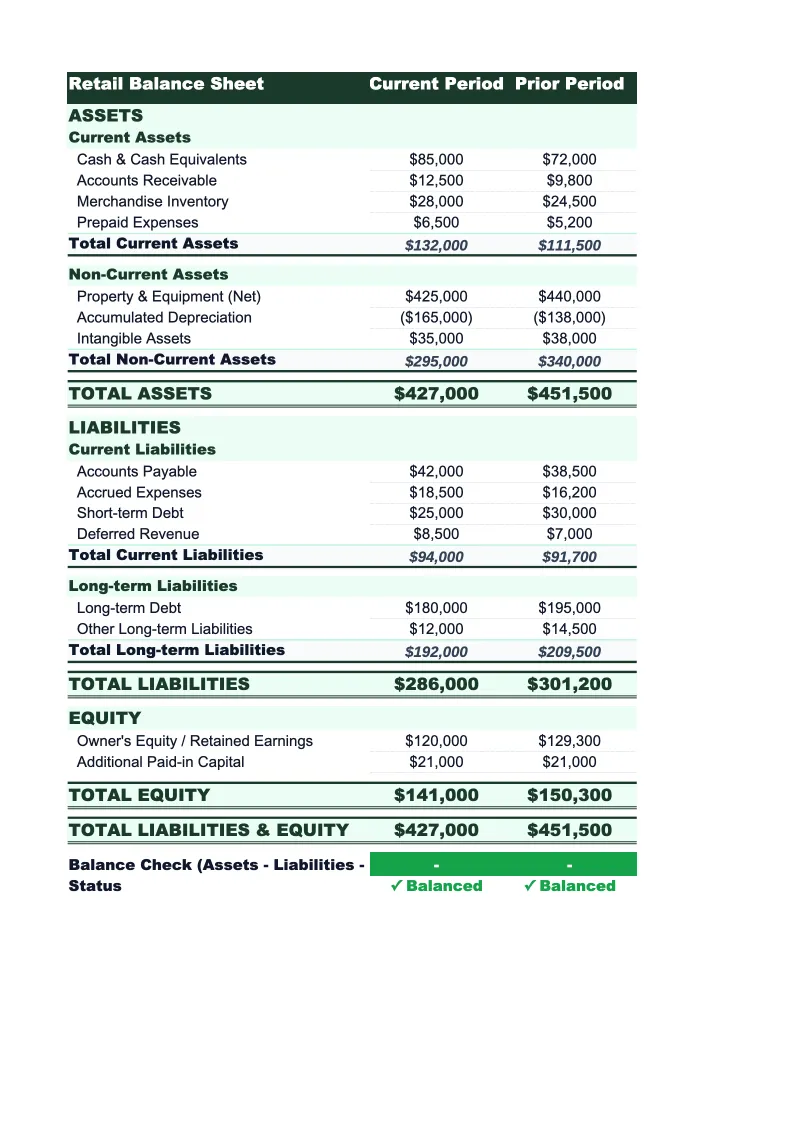
Retail Balance Sheet Template
See exactly what your retail store owns, owes, and is worth — a balance sheet built for retail with merchandise inventory by category, store fixture depreciation, shrinkage tracking, and seasonal liability visibility.
What's Inside This Retail Balance Sheet Template
This template includes 4 worksheets, each designed for a specific part of your retail financial workflow:
Balance Sheet
The main financial statement organized around the retail chart of accounts.
Inventory Tracker
A period-end merchandise count sheet that feeds inventory values into the balance sheet.
Fixed Assets
A fixed-asset register for every major piece of equipment, fixture, and improvement the store owns or has invested in.
Period Comparison
A side-by-side view of two balance sheet dates — most usefully the current quarter against the same quarter one year prior, or the pre-holiday and post-holiday balance sheet to capture seasonal swings.
Retail Balance Sheet Template Features
- Merchandise inventory tracker with category breakdowns, per-unit cost tracking, and slow-stock flags
- Store credit and layaway liability tracked as separate current liability line items
- Fixed asset register with depreciation schedules for fixtures, POS hardware, and leasehold improvements
- Accounts payable organized by vendor type — merchandise suppliers, service vendors, and utilities
- Accounting equation check — automatically flags any imbalance between assets and liabilities plus equity
- Period-over-period comparison view for lender reporting, SBA applications, and seasonal trend analysis
How to Use This Retail Balance Sheet Spreadsheet
Start with the Fixed Assets sheet before touching the main balance sheet. Pull your most recent depreciation schedule from your accountant or last year's tax return and list every major asset the store owns: display cases and shelving, POS systems and hardware, leasehold improvements (the build-out costs for your location), signage, and any vehicles used for deliveries. Enter the original cost, purchase date, and useful life for each item, and the sheet calculates depreciation and net book value automatically. These totals flow directly into the non-current assets section of the balance sheet — no manual entry needed on that sheet.
Next, run a physical inventory count and enter the results in the Inventory Tracker. Pull current unit costs from your most recent purchase invoices for each product category and the sheet will calculate ending inventory value and inventory turnover days. That ending inventory value is the most important number feeding into your current assets — it's typically the largest single asset on a retail balance sheet. Once the inventory is done, fill in the rest of the balance sheet: pull cash from your bank statement, accounts receivable from any outstanding wholesale or layaway orders, accounts payable from your vendor aging report, and store credit balances from your POS system.
15 minutes from download to your first retail balance sheet
Download the template, enter your inventory and accounts, and see your store's full financial position — assets, liabilities, store credit obligations, and owner's equity included.
Why Every Retail Store Needs a Balance Sheet Template
Retail stores operate on thin net margins — typically 2–6% — which means the entire financial health of the business rests on balance sheet management, not just revenue. The P&L tells you whether you made money last quarter; the balance sheet tells you whether the business can survive a slow January after a strong holiday season. For retail, that matters more than almost any other industry: Q4 often accounts for 20–30% of annual revenue, which means cash flow is inherently lumpy and the balance sheet at the end of January looks very different from the one at the end of November. Retailers who only track P&L without maintaining a balance sheet often discover cash problems only after they've already become crises.
Three items on a retail balance sheet require specific attention. The first is merchandise inventory — it's usually the largest current asset, it changes every period, and it needs to be valued at cost (what you paid for it) rather than retail price. Retailers who skip physical counts or use rough estimates end up with a balance sheet that significantly misstates the business's true position. The second is accounts payable terms: most retail stores carry significant vendor payables, and the balance sheet shows whether you're keeping payment current or stretching terms — a detail that matters when suppliers are evaluating your creditworthiness for next season's orders. The third is store credit and layaway liabilities: collected cash that represents future obligations, similar to gift cards in food service, that belongs on the liability side until the merchandise changes hands.
Retail Industry at a Glance
Financial templates built for retail businesses — from independent boutiques to specialty stores. Pre-loaded with product cost tracking, wholesale invoicing, and retail-specific KPIs.
Revenue Drivers
- In-store sales
- Online/e-commerce sales
- Wholesale orders
- Custom and special orders
Key Cost Categories
- Cost of goods sold
- Labor (sales staff)
- Rent & occupancy
- Inventory shrinkage
- Marketing & advertising
- Shipping & fulfillment
Typical Margins
Gross: 40-60% · Net: 2-6%
Seasonality
Q4 holiday season typically accounts for 20-30% of annual revenue; back-to-school (August) and spring sales are secondary peaks.
Key Performance Indicators
Retail Balance Sheet Template FAQ
More Retail Templates
Retail Budget Template for Excel
$29
Retail Business Plan Template for Excel
$39
Retail Cash Flow Template for Excel
$29
Retail Expense Tracker Template for Excel
$29
Retail Financial Model Template for Excel
$29
Retail Income Statement Template for Excel
$29
Retail Invoice Template for Excel
$29
Retail KPI Dashboard Template for Excel
$29
Retail P&L Template for Excel
$29
Retail Pro Forma Template for Excel
$29
Retail Project Budget Template for Excel
$29
Retail Sales Forecast Template for Excel
$29
Retail Business Valuation Template for Excel
$29
More Balance Sheet Templates
Retail Balance Sheet Template
$29