Retail Cash Flow Template
See exactly when cash comes in and goes out — daily sales receipts, inventory pre-buys, vendor payments, and rent — with a cash flow template built for retail store owners.
What's Inside This Retail Cash Flow Template
This template includes 5 worksheets, each designed for a specific part of your retail financial workflow:
Weekly Cash Flow
A 13-week rolling cash flow projection broken down by week — the right planning horizon for most retail operators.
Monthly Cash Flow
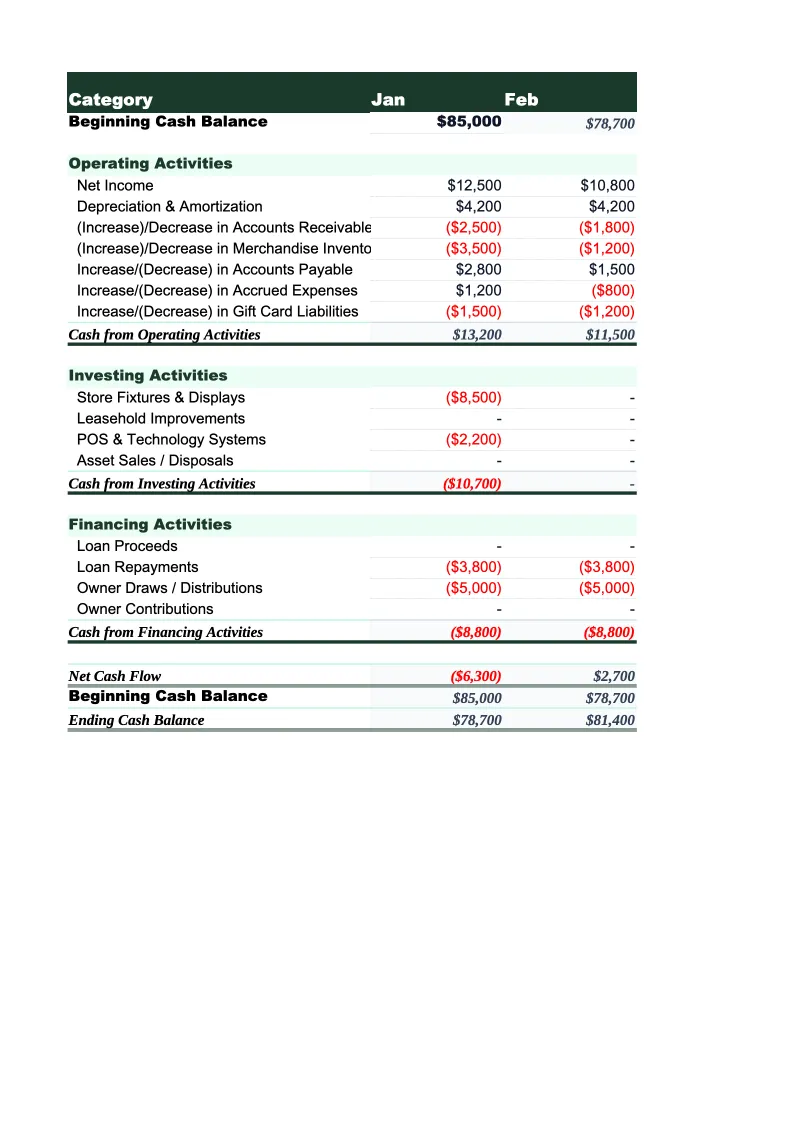
A 12-month view of cash inflows and outflows, separated into operating, investing, and financing activities.
Inventory Purchase Planner
A planning sheet built around the retail reality that you buy stock weeks before you sell it and pay for it weeks after you receive it.
Vendor Payment Schedule
A tracker for your regular supplier obligations — product vendors, packaging suppliers, display fixture vendors, and any service providers with recurring invoices.
Dashboard
A single-page visual summary showing current cash balance, 13-week cash runway, weekly cash inflow versus outflow trend, and a breakdown of where cash is going by category (inventory, labor, rent, and other).
Retail Cash Flow Template Features
- 13-week rolling cash flow with retail-specific line items (in-store sales, online revenue, inventory purchases, vendor payments)
- Inventory purchase planner showing the cash gap between stock buys and sell-through receipts
- Monthly cash flow statement formatted for bank and lender review
- Vendor payment schedule tracking supplier terms and weekly cash-out totals
- Credit card settlement timing built into daily cash receipt calculations
- Visual dashboard with 13-week cash runway and seasonal trend chart
How to Use This Retail Cash Flow Spreadsheet
Start with the Weekly Cash Flow sheet. Download the file, open it in Excel or Google Sheets, and enter your current bank balance in the starting cash cell. Fill in expected inflows for the next 13 weeks: projected weekly in-store and online sales by channel, any confirmed wholesale orders, and other expected income. Use the last 4-6 weeks of POS reports as your baseline — most store owners complete the inflow side in about 20 minutes. Then fill in outflows: upcoming inventory orders, your payroll schedule, and monthly fixed costs like rent and utilities. The credit card settlement row adjusts daily sales for the typical 1-3 day processing lag so your ending balance reflects cash that's actually in your account.
Set up the Vendor Payment Schedule with your regular supplier obligations. List each vendor, their typical invoice size, and payment terms. This usually takes 15-20 minutes if you have your accounts payable aging report handy. Then use the Inventory Purchase Planner for any upcoming stock orders: enter the order amount, expected delivery date, and supplier payment terms. The planner calculates when the cash actually leaves your account versus when you expect to sell through the merchandise and collect payment. Pay particular attention to the weeks where multiple vendor invoices, rent, and payroll all fall in the same 7-day window — those are the pressure points to plan around.
15 minutes from download to your first cash flow projection
Download the template, enter your current balance and upcoming sales and inventory orders, and see your store's 13-week cash position at a glance.
Why Every Retail Store Needs a Cash Flow Template
Retail stores fail financially for a specific reason that doesn't show up on a P&L: the inventory-to-cash gap. A store buys stock in advance, receives it weeks later, puts it on the floor, waits for customers to buy it, and then — after credit card processing — collects the cash 1-3 days after the sale. Meanwhile, the supplier invoice is due net 30 or net 60 from receipt. The entire cycle, from placing an order to collecting cash from the customer, can span 60-120 days. A store running 40-60% gross margins looks healthy on paper right up until the moment it can't fund payroll because three large vendor invoices hit in the same week as a slow sales stretch.
The cash dynamics that matter most in retail are different from what shows up in a budget or income statement. Seasonal inventory pre-buys are the biggest single cash event most retailers face each year — buying Q4 holiday merchandise in September or October requires a large outlay of cash 6-10 weeks before the revenue it generates starts flowing in. Returns in January reduce cash receipts just as the holiday inventory invoices come due. The holiday season may account for 20-30% of annual revenue, but the cash timing means that a store needs its strongest cash position entering Q4, not exiting it. A cash flow view makes this visible; gross margin calculations alone do not.
Retail Industry at a Glance
Financial templates built for retail businesses — from independent boutiques to specialty stores. Pre-loaded with product cost tracking, wholesale invoicing, and retail-specific KPIs.
Revenue Drivers
- In-store sales
- Online/e-commerce sales
- Wholesale orders
- Custom and special orders
Key Cost Categories
- Cost of goods sold
- Labor (sales staff)
- Rent & occupancy
- Inventory shrinkage
- Marketing & advertising
- Shipping & fulfillment
Typical Margins
Gross: 40-60% · Net: 2-6%
Seasonality
Q4 holiday season typically accounts for 20-30% of annual revenue; back-to-school (August) and spring sales are secondary peaks.
Key Performance Indicators
Retail Cash Flow Template FAQ
More Retail Templates
Retail Balance Sheet Template for Excel
$29
Retail Budget Template for Excel
$29
Retail Business Plan Template for Excel
$39
Retail Expense Tracker Template for Excel
$29
Retail Financial Model Template for Excel
$29
Retail Income Statement Template for Excel
$29
Retail Invoice Template for Excel
$29
Retail KPI Dashboard Template for Excel
$29
Retail P&L Template for Excel
$29
Retail Pro Forma Template for Excel
$29
Retail Project Budget Template for Excel
$29
Retail Sales Forecast Template for Excel
$29
Retail Business Valuation Template for Excel
$29
Retail Cash Flow Template
$29